
IAE Academy

GATE 2026 CS1 Q.15: solution and answer

GATE 2026 · CS1Q.15 · 1 mark · MCQ

Consider a processor P whose instruction set architecture is the load-store architecture. The instruction format is such that the first operand of any instruction is the destination operand.

Which one of the following sequences of instructions corresponds to the high-level language statement ?

Note: X, Y, and Z are memory operands. R0, R1, and R2 are registers.

  1. (A)

    ADD Z, X, Y

  2. (B)

    LOAD R0, X
    ADD Z, R0, Y

  3. (C)

    ADD R0, X, Y
    STORE Z, R0

  4. (D)

    LOAD R0, X
    LOAD R1, Y
    ADD R2, R0, R1
    STORE Z, R2
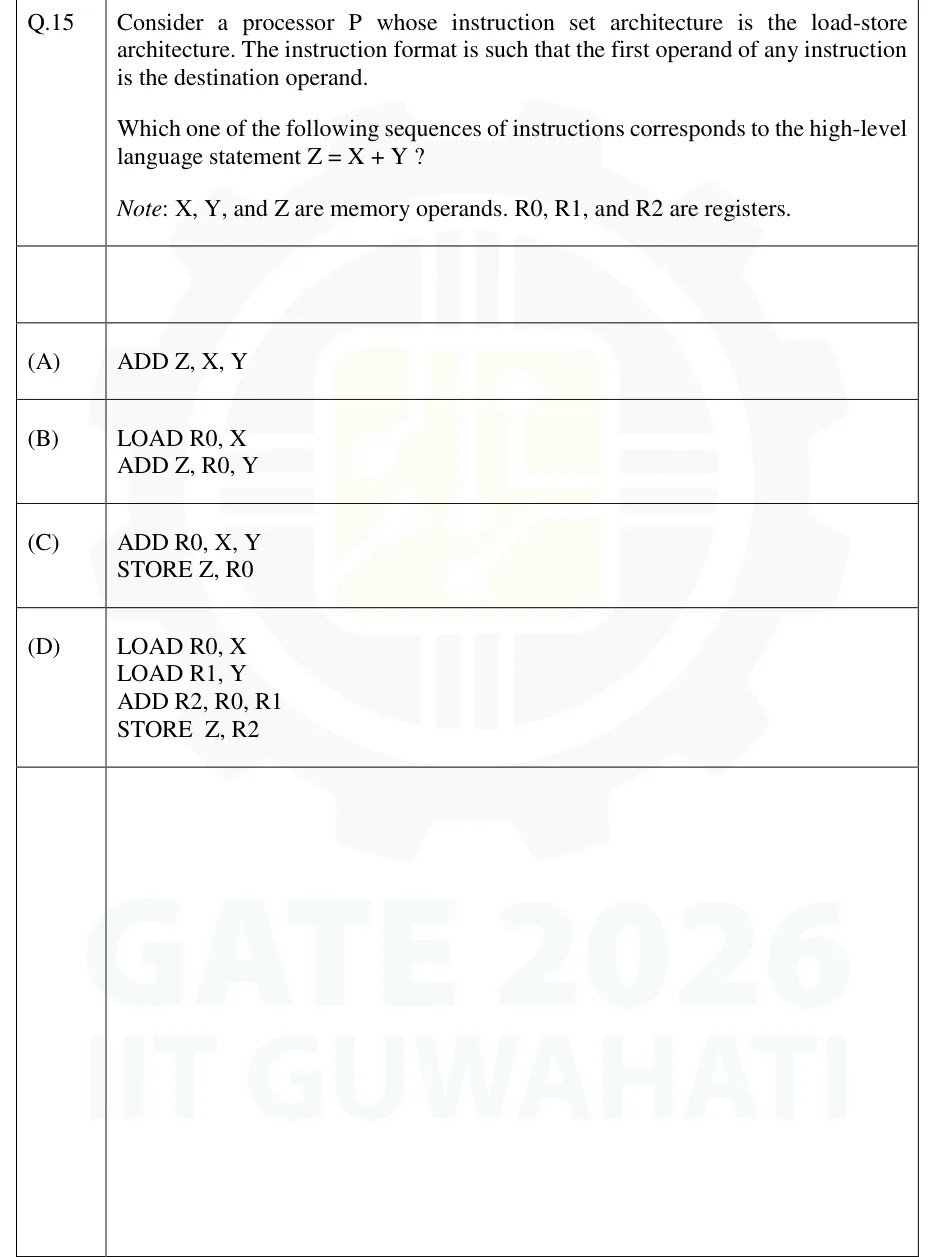
See the question in the paper

Answer and solution

ANSWER

The correct answer is option (D): LOAD R0, X / LOAD R1, Y / ADD R2, R0, R1 / STORE Z, R2.

Official answer: DSource: Official answer key, GATE 2026 CS1 (IIT Guwahati)

  1. In a load-store architecture, the memory can be touched only by LOAD (memory to register) and STORE (register to memory); every other instruction, including ADD, must operate purely on registers.

  2. Option (A) ADD Z, X, Y performs an ALU operation with all three operands in memory. This is an ALU instruction directly on memory operands, which a load-store architecture forbids. Eliminated.

  3. Option (B): LOAD R0, X brings X into R0, but the following ADD Z, R0, Y still writes its result directly to memory (Z) and reads one operand (Y) directly from memory. An ADD may not touch memory at all in a load-store machine. Eliminated.

  4. Option (C): ADD R0, X, Y reads both X and Y directly from memory (only the destination R0 is a register), which is disallowed for an ALU instruction; STORE Z, R0 alone does not fix the illegal ADD. Eliminated.

  5. Option (D): LOAD R0, X (memory to register, allowed), LOAD R1, Y (memory to register, allowed), ADD R2, R0, R1 (all three operands are registers, no memory access, allowed), STORE Z, R2 (register to memory, allowed). Every instruction obeys the load-store constraint, and the first operand is consistently the destination throughout.

  6. Only sequence (D) is fully compliant with the load-store architecture.

KEY IDEA

In a load-store (register-register) architecture, only LOAD and STORE instructions may reference memory; every arithmetic/logic instruction (like ADD) must have all its operands, source and destination, in registers.

WATCH OUT FOR

Assuming an ADD can have one memory operand as long as it also uses a register (as in options B and C), rather than recognizing that a load-store ISA forbids ANY memory operand on a non-load/store instruction.

From the GATE 2026 CS1 paper. Every question of this paper · Download the full paper · All 11 Instructions & addressing questions, with notes

More Instructions & addressing questions