
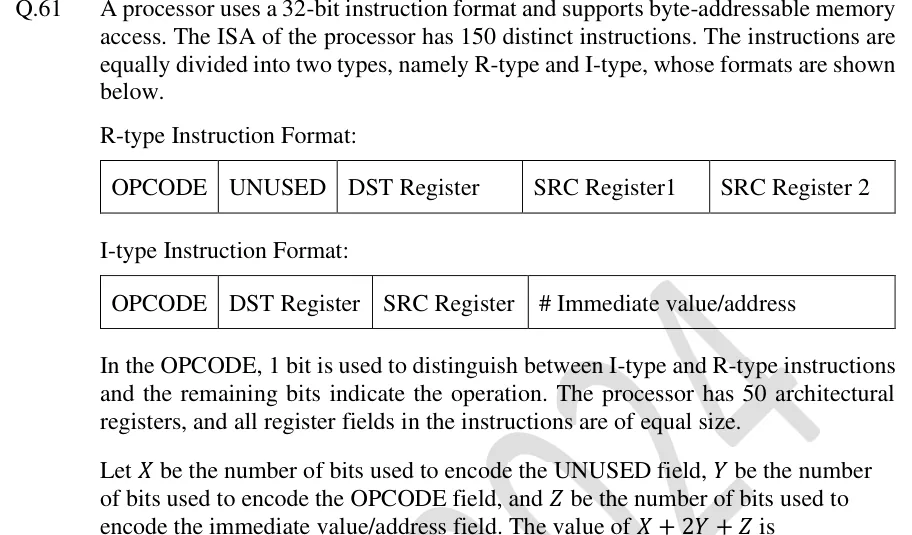
A processor uses a 32-bit instruction format and supports byte-addressable memory access. The ISA of the processor has 150 distinct instructions. The instructions are equally divided into two types, namely R-type and I-type, whose formats are shown below.
R-type Instruction Format (32 bits total, fields left to right):
| OPCODE | UNUSED | DST Register | SRC Register1 | SRC Register 2 |
I-type Instruction Format (32 bits total, fields left to right):
| OPCODE | DST Register | SRC Register | # Immediate value/address |
In the OPCODE, 1 bit is used to distinguish between I-type and R-type instructions and the remaining bits indicate the operation. The processor has 50 architectural registers, and all register fields in the instructions are of equal size.
Let be the number of bits used to encode the UNUSED field, be the number of bits used to encode the OPCODE field, and be the number of bits used to encode the immediate value/address field. The value of is ______ (answer in integer).
 Tap to open full size
Figure description
Two instruction-format diagrams, each a horizontal table of boxes summing to 32 bits total width (widths not drawn to scale, no bit counts marked on the image itself). R-type row (5 boxes, left to right): OPCODE, UNUSED, DST Register, SRC Register1, SRC Register 2. I-type row (4 boxes, left to right): OPCODE, DST Register, SRC Register, # Immediate value/address.