
IAE Academy

GATE 2026 EC Q.53: solution and answer

GATE 2026 · ECQ.53 · 2 marks · MCQ

A circuit using an ideal OP-AMP is shown in the Figure.

Which of the following options gives the correct value of the current ?
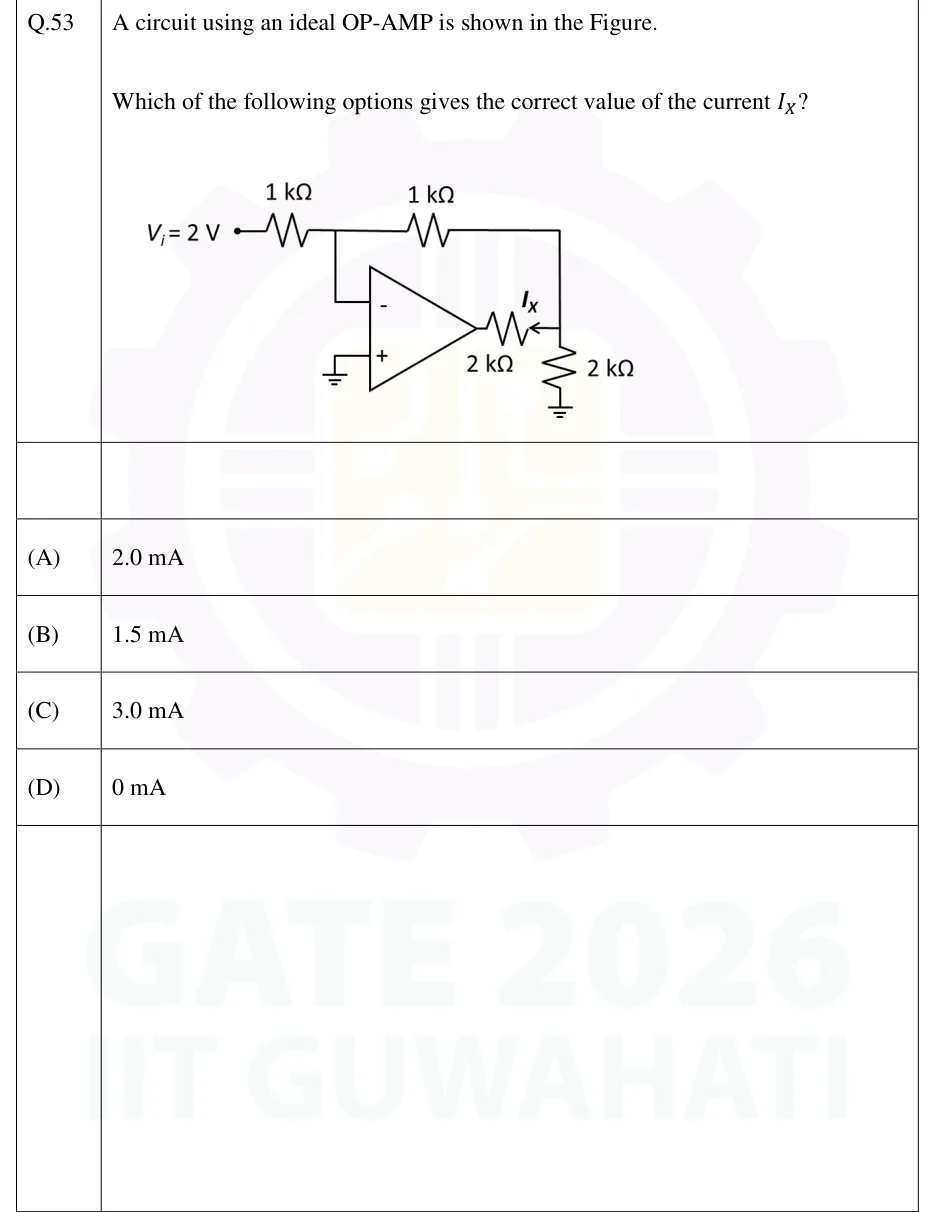
GATE 2026 EC question 53: Ideal op-amp with its non-inverting (+) input grounded.Tap to open full size
Figure from the GATE 2026 EC paper. It is part of the question.
Figure description

Ideal op-amp with its non-inverting (+) input grounded. Input source V_i = 2 V connects through a 1 k Ω resistor to the inverting (-) input node. A second 1 k Ω resistor runs from the inverting input node to a node on the right (call it X). The op-amp output connects to node X through a 2 k Ω resistor; the current I_X in this resistor is marked with an arrow pointing from node X toward the op-amp output. Node X is also connected to ground through another 2 k Ω resistor.

  1. (A)

    2.0 mA

  2. (B)

    1.5 mA

  3. (C)

    3.0 mA

  4. (D)

    0 mA

Answer and solution

ANSWER

, flowing from node X into the op-amp output. The answer is (C).

Official answer: CSource: Official answer key, GATE 2026 EC (IIT Guwahati)

  1. Assume an ideal op-amp with negative feedback. The output drives node X through the resistor, and node X feeds back to the inverting input through the resistor. If rises, rises and so does , which pulls back down, so the feedback is negative. That gives a virtual short, , and no current flows into either op-amp input.

  2. Current in the input resistor (Ohm's law): , flowing toward the inverting node.

  3. No current enters the op-amp input, so the same flows on through the feedback resistor, from the inverting node into node X. Therefore .

  4. Current in the grounded resistor: , flowing from ground into node X.

  5. KCL at node X. The arrow shows leaving X toward the op-amp output, so the two currents entering X must both leave as :

  6. Check: . That is a finite output, so the ideal op-amp stays in its linear region and sinks . The answer is (C).

KEY IDEA

With a virtual ground at the inverting input, the input current has to pass through the feedback resistor, which puts node X at . The op-amp output then has to sink this as well as the drawn from ground through the load (KCL at X).

WATCH OUT FOR

Picking 2.0 mA by assuming the output resistor carries only the feedback current, which ignores the in the grounded resistor at node X. Another mistake is to treat the circuit as a plain inverting amplifier with gain , so that is taken to be the output voltage. The op-amp output is actually on the far side of the resistor, at .

From the GATE 2026 EC paper. Every question of this paper · Download the full paper · All 36 Op-amps questions, with notes

More Op-amps questions