
IAE Academy

GATE 2025 EC Q.29: solution and answer

GATE 2025 · ECQ.29 · 1 mark · MSQ

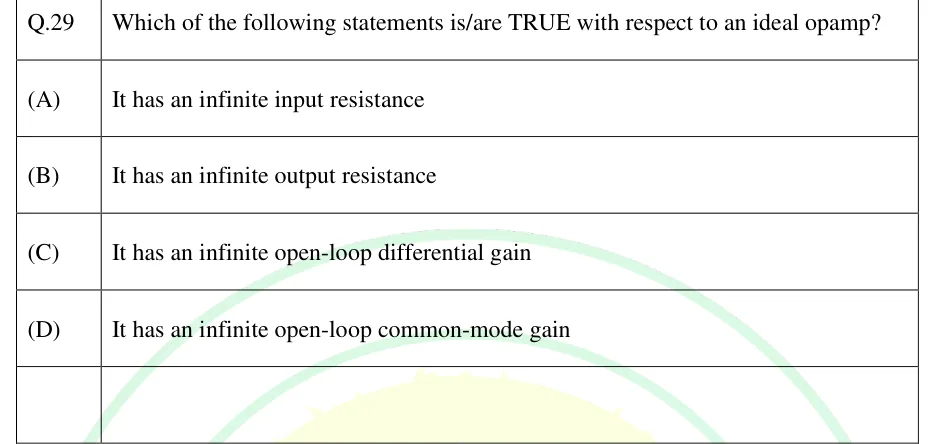
Which of the following statements is/are TRUE with respect to an ideal opamp?

  1. (A)

    It has an infinite input resistance

  2. (B)

    It has an infinite output resistance

  3. (C)

    It has an infinite open-loop differential gain

  4. (D)

    It has an infinite open-loop common-mode gain
See the question in the paper

Answer and solution

ANSWER

Options (A) and (C) are TRUE. An ideal op-amp has infinite input resistance and infinite open-loop differential gain. Its output resistance is zero and its common-mode gain is zero.

Official answer: A, CSource: Official answer key, GATE 2025 EC (IIT Roorkee)

  1. Ideal op-amp model. Treat the ideal op-amp as a voltage-controlled voltage source with input resistance , output resistance , differential gain , common-mode gain (so ) and infinite bandwidth.

  2. (A) Input resistance. , so the input terminals draw no current (). That is why KCL at the inverting node can be written with zero input current. TRUE.

  3. (B) Output resistance. An ideal voltage source has zero internal resistance, so and does not depend on the load. An infinite describes an ideal current source, not a voltage amplifier. FALSE.

  4. (C) Open-loop differential gain. . With negative feedback and a finite , this gives , which is the virtual short. TRUE.

  5. (D) Open-loop common-mode gain. An ideal op-amp rejects any signal common to both inputs completely, so and . An infinite common-mode gain would be the worst possible amplifier, not the ideal one. FALSE.

  6. The true statements are (A) and (C).

KEY IDEA

The ideal op-amp is an ideal voltage-controlled voltage source that responds only to the difference between its inputs. Its input resistance and differential gain are infinite; its output resistance and common-mode gain are zero, so CMRR is infinite.

WATCH OUT FOR

Marking every option with the word "infinite". Output resistance is zero, not infinite: an ideal voltage source must not depend on the load. Common-mode gain is zero, not infinite: it is the CMRR that is infinite. Students often mix up and CMRR.

From the GATE 2025 EC paper. Every question of this paper · Download the full paper · All 36 Op-amps questions, with notes

More Op-amps questions