
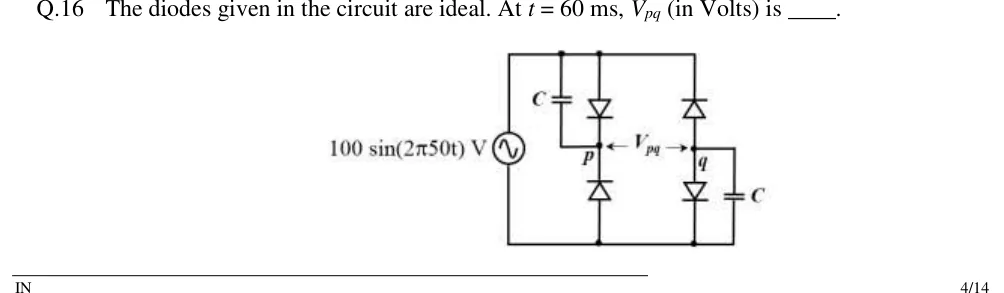
The diodes given in the circuit are ideal. At , (in Volts) is ____.
 Tap to open full size
Figure description
A sinusoidal source 100 sin (2 π 50t) V on the left, connected between a top rail (call it A) and a bottom rail (call it B); no polarity marks are printed. Between the rails there are two vertical branches and two capacitors. Left branch: a diode from the top rail down to node p, triangle pointing down (anode on the top rail, cathode at p), and a diode from the bottom rail up to node p, triangle pointing up (anode on the bottom rail, cathode at p). A capacitor C runs from the top rail down to a wire that joins node p, so C sits between the top rail and p, directly across the upper diode. Right branch: a diode between node q and the top rail, triangle pointing up (anode at q, cathode on the top rail), and a diode from node q down to the bottom rail, triangle pointing down (anode at q, cathode on the bottom rail). A second capacitor C goes from node q (via a wire to the right) down to the bottom rail, so it sits directly across the lower right diode. An arrow labelled V_pq points between nodes p and q; nothing else is connected between p and q.