
IAE Academy

GATE 2020 EC Q.44: solution and answer

GATE 2020 · ECQ.44 · 2 marks · NAT

In the voltage regulator shown below, is the unregulated input at 15 V. Assume and the base current is negligible for both the BJTs. If the regulated output is 9 V, the value of is ________ .
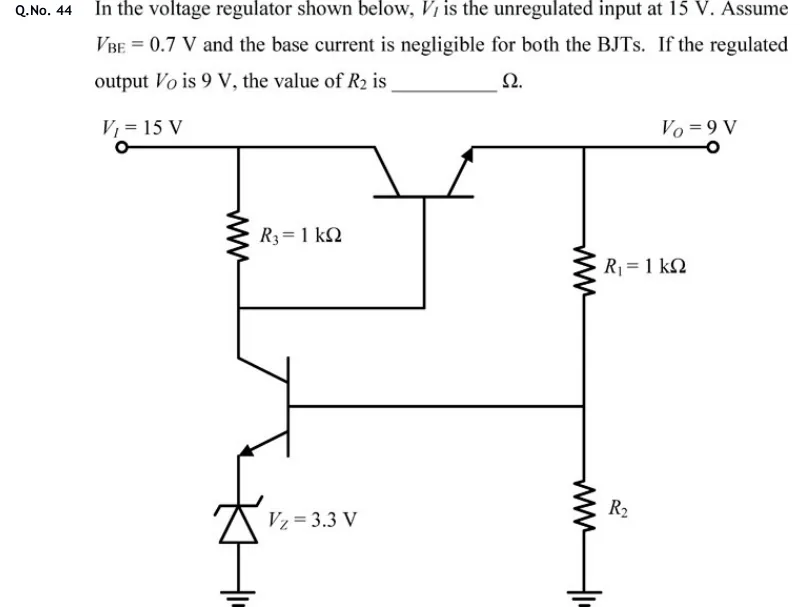
GATE 2020 EC question 44: Series transistor voltage regulator.Tap to open full size
Figure from the GATE 2020 EC paper. It is part of the question.
Figure description

Series transistor voltage regulator. Input terminal V_I = 15 V at top left; output terminal V_O = 9 V at top right. Pass transistor Q1 (NPN) sits in the top line: collector connected to the V_I line, emitter (arrow pointing outward) connected to the V_O line, base pointing downward. From the V_I line, resistor R3 = 1 kΩ goes down to a node; that node connects to the base of Q1 and to the collector of a second NPN transistor Q2 (error amplifier). Q2 emitter (arrow outward) goes down to the cathode of a Zener diode V_Z = 3.3 V whose anode is grounded. On the output side, a voltage divider from V_O to ground: R1 = 1 kΩ on top, R2 at the bottom; the R1–R2 junction is connected by a horizontal wire to the base of Q2.

Answer and solution

ANSWER

Official answer: 800Source: Official answer key, GATE 2020 EC (IIT Delhi)

  1. Assumptions stated in the question: both BJTs are in the active region with , and both base currents are negligible. So the base of draws no current from the – junction.

  2. The emitter of sits on the cathode of the reverse-biased Zener, whose anode is grounded. So .

  3. KVL across the base-emitter junction of :

  4. The base current of is zero, so comes from an unloaded voltage divider across the output:

  5. Substitute and :

  6. Check that the operating point is consistent. , so carries . The base current of is negligible, so this whole current flows into the collector of and down through the Zener. The Zener is therefore reverse-biased and conducting. is active because , and is active because . The assumptions hold.

KEY IDEA

In a series regulator with an error-amplifier transistor, the feedback loop settles where the sampled output at the divider tap equals the reference plus one base-emitter drop: . This is the same as . and only set the bias current, not the output.

WATCH OUT FOR

Setting the divider tap equal to and forgetting the of . That gives . Other mistakes are putting the of the pass transistor into the divider equation, or trying to use and to find . Neither of those affects the divider.

From the GATE 2020 EC paper. Every question of this paper · Download the full paper · All 25 Diode circuits questions, with notes

More Diode circuits questions