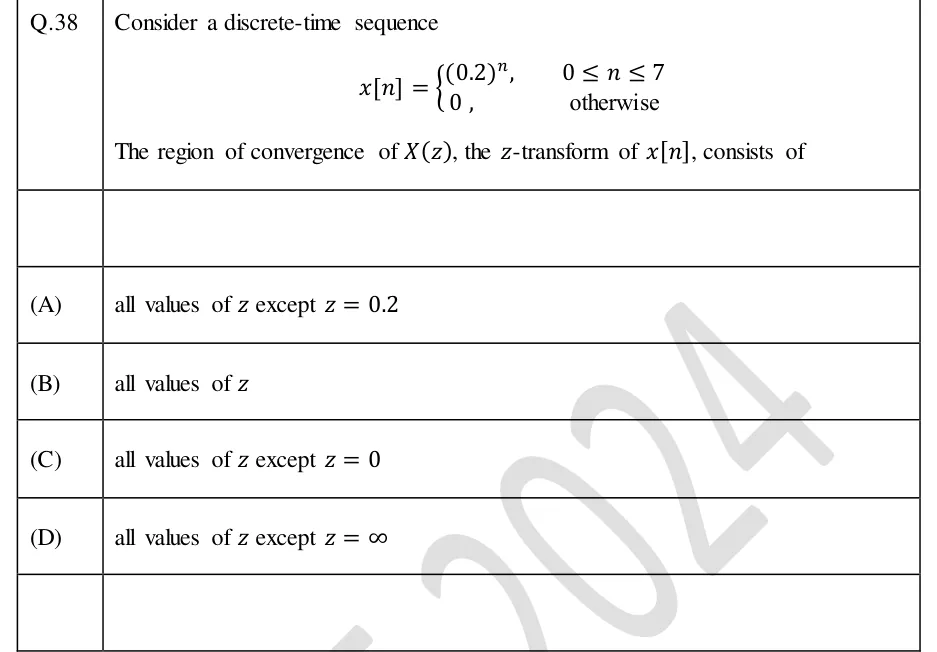
Consider a discrete-time sequence
The region of convergence of , the -transform of , consists of
- (A)
all values of except
- (B)
all values of
- (C)
all values of except
- (D)
all values of except

Consider a discrete-time sequence
The region of convergence of , the -transform of , consists of
all values of except
all values of
all values of except
all values of except
ANSWER
The ROC is all values of except : option (C).
Official answer: CSource: Official answer key, GATE 2024 IN (IISc Bengaluru)
Write the -transform directly from the definition. Since is non-zero only for : This is a finite sum of 8 terms, so it converges wherever every term is finite. No condition like comes in, because there is no infinite series to converge.
Check each term for finite, non-zero : the term is the constant 1, and every term with contains , which is finite for every . At these terms are infinite, so is excluded.
Check : every with goes to 0, so , which is finite. The sequence has no terms with , so contains no positive powers of , and belongs to the ROC.
Confirm with the closed form (finite geometric series, ratio ):
The factor in the denominator is not a real pole. The numerator vanishes at , , and the zero is exactly , so it cancels. This must happen, because the sum in step 1 is plainly finite at (it equals ).
The only poles left are the 7 poles at (from ). So the ROC is the whole -plane except , which is option (C).
KEY IDEA
A finite-length sequence has a finite sum for its -transform, so the ROC is the whole -plane with at most two points taken out: is excluded if the sequence has any non-zero sample at (a term), and is excluded if it has any non-zero sample at (a term). Here all samples are at , so only is excluded.
WATCH OUT FOR
Writing the geometric-series closed form , seeing the denominator vanish at , and choosing (A) or setting the ROC to as for the infinite sequence . That pole is cancelled by a zero of the numerator. The other common slip is choosing (B) because 'finite sequences converge everywhere', forgetting that the terms blow up at .
From the GATE 2024 IN paper. Every question of this paper · Download the full paper · All 12 z-transform questions, with notes