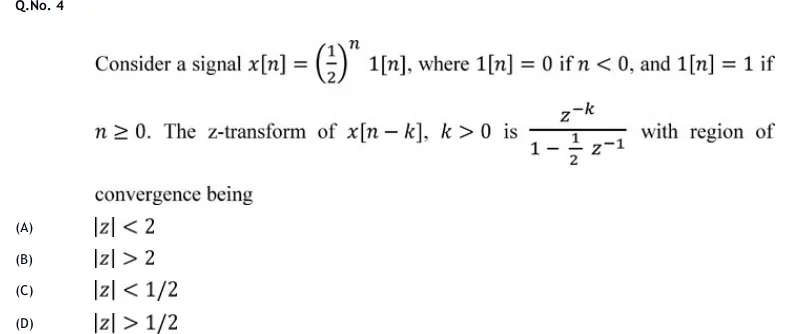
Consider a signal , where if , and if . The z-transform of , is with region of convergence being
- (A)
- (B)
- (C)
- (D)

Consider a signal , where if , and if . The z-transform of , is with region of convergence being
ANSWER
The ROC is : option (D).
Official answer: DSource: Official answer key, GATE 2020 EE (IIT Delhi)
Write down the delayed signal. With , which is zero for and equal to for . Because , the sequence is right-sided and causal.
Take the z-transform directly. Put :
Convergence condition. The geometric series converges only when , that is, when . Its sum there is , so which is the expression given in the question. The factor is finite at every , and is already outside , so the delay does not shrink the region.
Check with the poles. Written in positive powers, It has a pole at . For it also has a pole of order at ; for there is no pole at the origin. The outermost pole is at . A right-sided sequence has its ROC outside the outermost pole, and because this one is causal the ROC also includes . So the ROC is .
Rule out the other options. (A) and (C) are regions inside a circle, which belong to left-sided sequences. (B) lies inside the true ROC but is not all of it, because the series also converges for . The answer is (D).
KEY IDEA
is a right-sided exponential with a single pole at , so its ROC is . Delaying it by multiplies the transform by . That factor can only change whether or belongs to the ROC, and is already outside it, so the ROC stays .
WATCH OUT FOR
Inverting the pole and writing : the pole sits at , not at . A second mistake is to think the factor , or the shift itself, turns the sequence left-sided and gives . A delay by keeps the sequence causal. Some students also say adds a pole of order at the origin. In fact already has a zero there, so the pole has order (none when ). Either way the annulus does not change.
From the GATE 2020 EE paper. Every question of this paper · Download the full paper · All 12 z-transform questions, with notes