
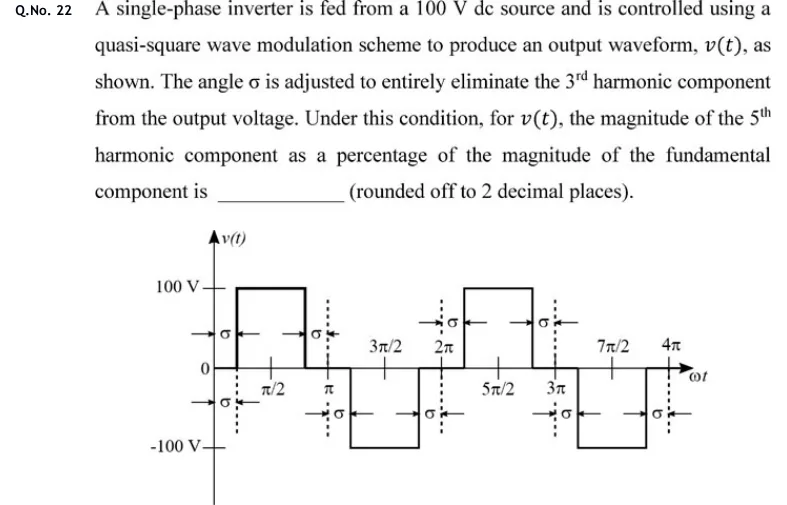
A single-phase inverter is fed from a 100 V dc source and is controlled using a quasi-square wave modulation scheme to produce an output waveform, v(t), as shown. The angle σ is adjusted to entirely eliminate the 3rd harmonic component from the output voltage. Under this condition, for v(t), the magnitude of the 5th harmonic component as a percentage of the magnitude of the fundamental component is ______ (rounded off to 2 decimal places).
 Tap to open full size
Figure description
Plot of v(t) versus ωt with vertical axis marked +100 V, 0 and -100 V, and horizontal axis marked π/2, π, 3π/2, 2π, 5π/2, 3π, 7π/2, 4π. The wave is a quasi-square wave. It is at 0 for an angle σ at the start, then +100 V from ωt = σ to ωt = π − σ, then 0 for an angle σ on each side of π. It is then -100 V from ωt = π + σ to ωt = 2π − σ, then 0 for an angle σ on each side of 2π. The pattern repeats: +100 V from 2π + σ to 3π − σ, and -100 V from 3π + σ to 4π − σ. The zero intervals of width σ are marked with arrows and σ labels. The wave is odd-symmetric and quarter-wave symmetric about π/2.