
IAE Academy

GATE 2018 EE Q.19: solution and answer

GATE 2018 · EEQ.19 · 1 mark · NAT

In the two-port network shown, the parameter in ohms is ________ (up to 2 decimal places).
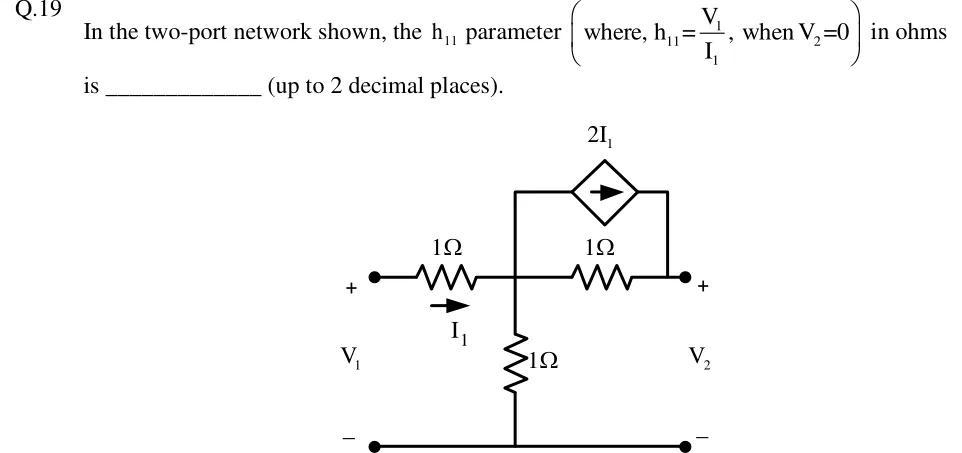
GATE 2018 EE question 19: A two-port network with a common bottom (ground) rail running from the port-1 minus terminal to the port-2 minus terminal.Tap to open full size
Figure from the GATE 2018 EE paper. It is part of the question.
Figure description

A two-port network with a common bottom (ground) rail running from the port-1 minus terminal to the port-2 minus terminal. From the port-1 plus terminal (voltage V_1, + on top, − at the bottom rail), a 1 Ω series resistor runs right to a central node A. Current I_1 flows through this resistor from the port-1 terminal towards node A (arrow pointing right). Node A has three connections: (i) a 1 Ω shunt resistor from node A down to the bottom rail; (ii) a 1 Ω series resistor from node A right to node B, the port-2 plus terminal (voltage V_2, + on top, − at the bottom rail); (iii) a wire rising from node A to a diamond-shaped dependent current source of value 2I_1 (current-controlled by the port-1 current I_1), whose arrow points right, and whose right end drops down to node B. So the 2I_1 source is in parallel with the 1 Ω resistor between A and B and drives current from node A to node B.

Answer and solution

ANSWER

Official answer: 0.45 to 0.55Source: Official answer key, GATE 2018 EE (IIT Guwahati)

  1. Apply the test condition. is measured with , so short port 2: node B (the port-2 + terminal) is now at the potential of the bottom rail. Let be the voltage of the central node A with respect to the bottom rail.

  2. KCL at node A (current in = current out): enters through the input 1 Ω resistor. Current leaves through the 1 Ω shunt (), through the 1 Ω resistor to the shorted node B (), and through the dependent source, which carries from A towards B:

  3. Solve for the node voltage: The node voltage is negative because the dependent source takes more current out of node A () than brings in, so the two resistors must return the difference to node A.

  4. KVL around the input loop (port-1 + terminal, through the 1 Ω resistor, to node A, then to the bottom rail):

  5. The h-parameter:

KEY IDEA

is the input impedance with the output shorted. Set so that node B is grounded, write one KCL equation at the central node with the controlled source current included, and then . You cannot simplify the network with series/parallel reduction because the controlled source depends on . The dependent source lowers the input impedance from the passive value to .

WATCH OUT FOR

Ignoring the dependent source, or treating it as disappearing when port 2 is shorted, and reporting the passive value . With the source is not removed. It still takes out of node A (into the short), so it must stay in the KCL equation. A second slip is getting its direction wrong (taking as entering node A). That gives and .

From the GATE 2018 EE paper. Every question of this paper · Download the full paper · All 11 Two-port questions, with notes

More Two-port questions