
IAE Academy

GATE 2025 IN Q.61: solution and answer

GATE 2025 · INQ.61 · 2 marks · NAT

In the circuit shown, the galvanometer (G) has an internal resistance of 100 Ω. The galvanometer current is ________ μA (rounded off to the nearest integer).
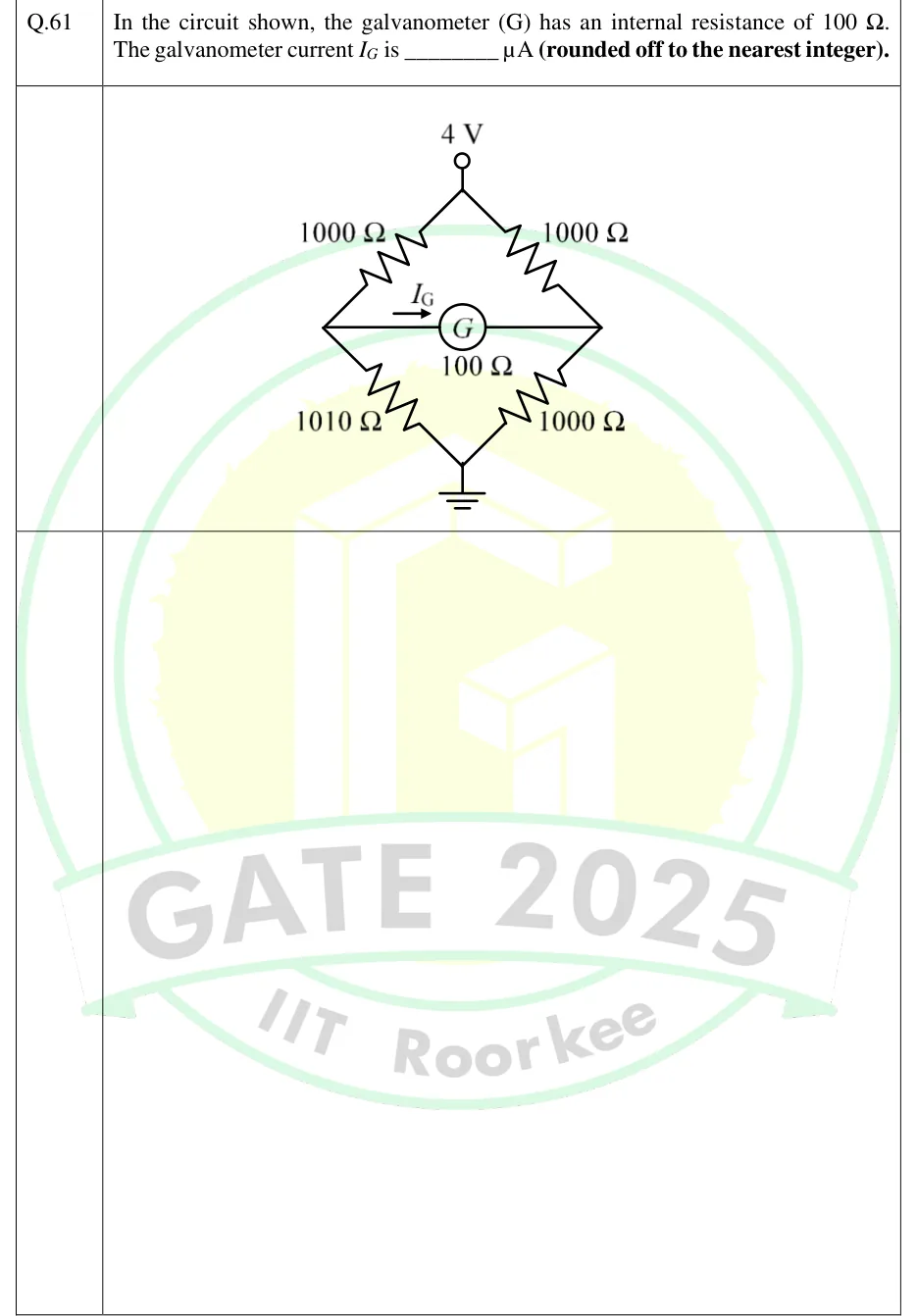
GATE 2025 IN question 61: A Wheatstone bridge drawn as a diamond.Tap to open full size
Figure from the GATE 2025 IN paper. It is part of the question.
Figure description

A Wheatstone bridge drawn as a diamond. The top vertex is a terminal held at 4 V (with respect to ground); the bottom vertex is connected to ground. Left arm: a 1000 Ω resistor from the top vertex to the left node, then a 1010 Ω resistor from the left node down to the grounded bottom vertex. Right arm: a 1000 Ω resistor from the top vertex to the right node, then a 1000 Ω resistor from the right node down to the grounded bottom vertex. A galvanometer G of internal resistance 100 Ω is connected horizontally between the left node and the right node. The current I_G is marked by an arrow pointing to the right, i.e. flowing from the left node through G to the right node.

Answer and solution

ANSWER

The galvanometer current is , which rounds to 9 μA and flows from the left node to the right node, the same way as the arrow.

Official answer: 9Source: Official answer key, GATE 2025 IN (IIT Roorkee)

  1. Label the left mid-node (between the 1000 Ω and 1010 Ω resistors) and the right mid-node (between the two 1000 Ω resistors). Remove G and find the Thevenin equivalent seen across -.

  2. Voltage divider on the left arm: .

  3. Voltage divider on the right arm: .

  4. Open-circuit (Thevenin) voltage: . is the positive terminal, so the current flows from to through G, the same direction as the arrow; is positive.

  5. Thevenin resistance: replace the 4 V source by a short, so the top and bottom vertices are both at ground. Then from the two left resistors are in parallel, and from the two right resistors are in parallel: (exactly ).

  6. Reconnect G (100 Ω) across the Thevenin equivalent:

  7. Rounded off to the nearest integer: .

KEY IDEA

A slightly unbalanced Wheatstone bridge with a galvanometer of finite resistance is solved with Thevenin's theorem. Remove G. The open-circuit voltage between the two mid-nodes is the difference between the two voltage dividers. With the source shorted, the Thevenin resistance is (upper-left ∥ lower-left) + (upper-right ∥ lower-right). Then .

WATCH OUT FOR

Using gives about 99.5 μA because it leaves out the bridge's own Thevenin resistance of about 1002.5 Ω. Another common error is to put the arm resistors in series (1000 + 1010) instead of in parallel when finding : once the source is shorted, the top and bottom vertices are the same node. Rounding to 2.01 V too early gives = 10 mV and about 9.07 μA. That still rounds to 9 here, but on a tighter question the lost precision would matter.

From the GATE 2025 IN paper. Every question of this paper · Download the full paper · All 16 Theorems questions, with notes

More Theorems questions