
IAE Academy

GATE 2023 EE Q.51: solution and answer

GATE 2023 · EEQ.51 · 2 marks · NAT

For the circuit shown, if , the instantaneous value of the Thevenin's equivalent voltage (in Volts) across the terminals - at time ms is ______ (Round off to 2 decimal places).
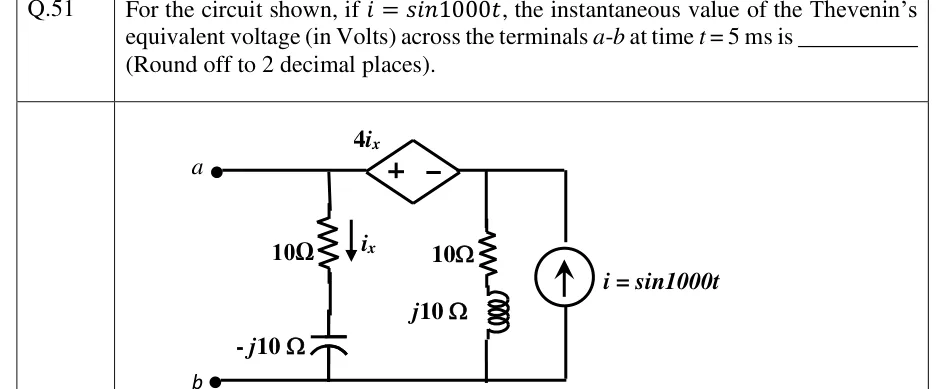
GATE 2023 EE question 51: Three parallel paths between a top rail and a bottom rail.Tap to open full size
Figure from the GATE 2023 EE paper. It is part of the question.
Figure description

Three parallel paths between a top rail and a bottom rail. Terminal a is at the left end of the top rail, and terminal b is at the left end of the bottom rail, which is the common return. Going right from a, the top rail reaches node A. Branch 1 runs from node A down to the bottom rail: a 10 Ω resistor in series with a capacitor of impedance -j10 Ω. Its current i_x flows downward. Continuing right from node A along the top rail is a diamond-shaped dependent voltage source 4i_x, with + on the left (node A side) and - on the right. The source's right end is node B. Branch 2 runs from node B down to the bottom rail: a 10 Ω resistor in series with an inductor of impedance j10 Ω. At the far right, an independent current source i = sin 1000t connects the bottom rail to node B, with its arrow pointing up, so it pushes current into node B. Terminals a-b are open.

Answer and solution

ANSWER

The Thevenin voltage is , so at it is .

Official answer: -12.1 to -11.9Source: Official answer key, GATE 2023 EE (IIT Kanpur)

  1. Work in phasors at , taking the source as the sine reference with its peak value: (peak). The reactances are given directly on the figure. With - open, no current leaves through terminal , so is the voltage at node A (the top of the branch).

  2. Branch 1 (Ohm's law): .

  3. Dependent source (+ at A, - at B): .

  4. KCL at node B: the source current splits between the branch and the path through the dependent source to node A. Because terminal is open, all the current reaching node A must go down branch 1, so the dependent-source path carries exactly :

  5. Simplify: . So and .

  6. Thevenin voltage: This is purely real, so (peak) is in phase with the source current. (Check: , and , as required.)

  7. Back to the time domain: .

  8. At the argument is (radians, not degrees): .

KEY IDEA

With - open, is just the open-circuit voltage at node A. Because no current leaves through terminal , the current through the dependent source equals the controlling current . That turns the circuit into one KCL equation at node B with one unknown, . The resulting transfer is purely real, so the Thevenin voltage is in phase with .

WATCH OUT FOR

Working out with the calculator in degree mode gives . The argument is in radians, so the answer is . Other slips: writing the dependent-source KVL with the polarity reversed (), and assuming the source path carries none of the current or all of it, when with - open it carries exactly .

From the GATE 2023 EE paper. Every question of this paper · Download the full paper · All 16 Theorems questions, with notes

More Theorems questions