
IAE Academy

GATE 2022 IN Q.54: solution and answer

GATE 2022 · INQ.54 · 2 marks · NAT

Given Circuit A with currents and as shown, the current in Circuit B (in amperes), is ________ (round off to one decimal place)
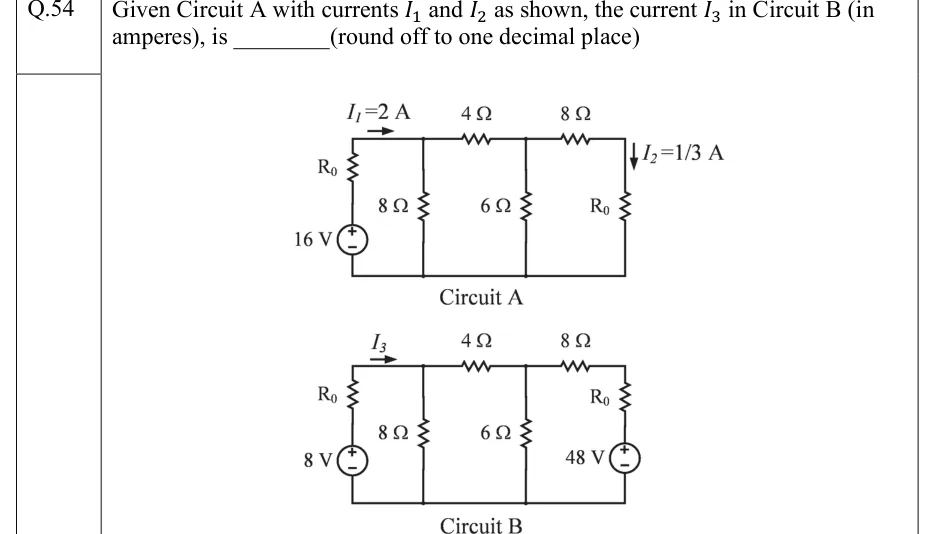
GATE 2022 IN question 54: Two separate ladder circuits, A and B, each with its own bottom rail (the reference node).Tap to open full size
Figure from the GATE 2022 IN paper. It is part of the question.
Figure description

Two separate ladder circuits, A and B, each with its own bottom rail (the reference node). Circuit A: The left branch has a 16 V source (+ terminal on top) with R_0 in series above it, running from the bottom rail up to the top wire. Current I_1 = 2 A is marked by an arrow pointing right in the top wire, from R_0 into top node 1. Node 1 has an 8 Ω resistor down to the bottom rail. A 4 Ω series resistor on the top wire joins node 1 to node 2. Node 2 has a 6 Ω resistor down to the bottom rail. An 8 Ω series resistor on the top wire joins node 2 to node 3. Node 3 has a resistor R_0 down to the bottom rail, and the current through it is marked I_2 = 1/3 A flowing downward. Circuit B: The ladder is the same: 8 Ω shunt at node 1, 4 Ω series, 6 Ω shunt at node 2, 8 Ω series. The left branch is an 8 V source (+ terminal on top) with R_0 in series above it. Current I_3 is marked by an arrow pointing right in the top wire, from R_0 into node 1. The rightmost branch, from node 3 to the bottom rail, is R_0 in series with a 48 V source (+ terminal on top, source below R_0).

Answer and solution

ANSWER

. The 8 V source alone gives (Circuit A at half the voltage), and the 48 V source alone gives (Circuit A reversed by reciprocity, at 3 times the voltage and pushing the other way). The two cancel.

Official answer: 0.0Source: Official answer key, GATE 2022 IN (IIT Kharagpur)

  1. Superposition. Circuit B is linear, so . Here is the current with only the 8 V source acting (48 V replaced by a short) and is the current with only the 48 V source acting (8 V replaced by a short). Each stays in its branch, so the passive network in both cases is exactly the resistor network of Circuit A.

  2. 8 V acting alone (homogeneity). With the 48 V shorted, the right branch is just , so the network is exactly Circuit A driven by 8 V instead of 16 V. Every current scales by the same factor:

  3. Reciprocity theorem. In Circuit A, 16 V in the left branch pushes current up that branch (in the direction) and produces downward in the right branch, which is just . By reciprocity, 16 V placed in series with the right-hand and oriented to push current downward in that branch (+ terminal at the bottom) would produce in the left branch, now just , flowing in the direction, which is the direction.

  4. 48 V acting alone. The 48 V source has its + terminal on top, so it pushes current upward in the right branch, opposite to the orientation used in step 3. Scale linearly and reverse the sign:

  5. Add the two parts.

  6. Check by finding from Circuit A. Call the voltages at the three top nodes . With : and . The 4 Ω current is , so . KVL in the left branch gives . Solving gives and . KCL at node 1 confirms it: .

  7. Nodal analysis on Circuit B with . The solution is , , (node 1: ; node 2: ; node 3: ). Then , which matches step 5. To one decimal place, .

KEY IDEA

Circuit B has the same resistor network as Circuit A, so you don't need . Use superposition. With only the left source acting, Circuit A is scaled by homogeneity: 8 V instead of 16 V gives half of . With only the right source acting, apply reciprocity to Circuit A: 16 V in the left branch gives A in the right branch, so 16 V in the right branch gives A in the left branch. Then scale by 48/16 and fix the sign from the source's polarity.

WATCH OUT FOR

The usual mistake is the sign of the 48 V contribution. Reciprocity needs the moved source to push current in the same sense as the reference direction of the branch whose current is measured, here downward through the right-hand . The 48 V source has + on top and pushes current upward, so its contribution is A, not A. Getting this wrong gives 2.0 A. Two other slips: forgetting that the 8 V source gives only half of (1 A, not 2 A), and making algebra errors while solving for when it isn't needed.

From the GATE 2022 IN paper. Every question of this paper · Download the full paper · All 16 Theorems questions, with notes

More Theorems questions