
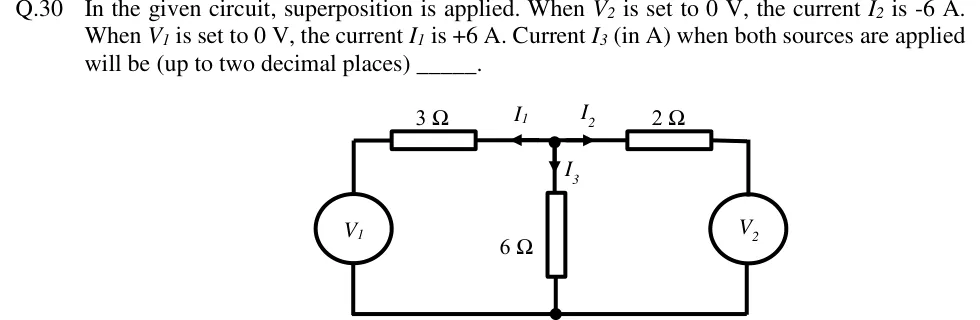
In the given circuit, superposition is applied. When is set to 0 V, the current is A. When is set to 0 V, the current is A. Current (in A) when both sources are applied will be (up to two decimal places) ______.
 Tap to open full size
Figure description
Two-mesh circuit with a common bottom (reference) wire. Left branch: independent voltage source V_1 (circle, no polarity marks shown) connected from the bottom wire up to the top-left corner, then a 3 Ω resistor along the top wire to a central top node (call it A). Right branch: from node A a 2 Ω resistor along the top wire to the top-right corner, then down through independent voltage source V_2 (circle, no polarity marks shown) to the bottom wire. Middle branch: a 6 Ω resistor from node A straight down to the bottom wire (a dot marks the junction on the bottom wire). Current reference directions, all drawn at node A: I_1 on the top wire pointing left (from A toward the 3 Ω resistor), I_2 on the top wire pointing right (from A toward the 2 Ω resistor), I_3 pointing downward from A into the 6 Ω resistor. So all three currents are defined as leaving node A.