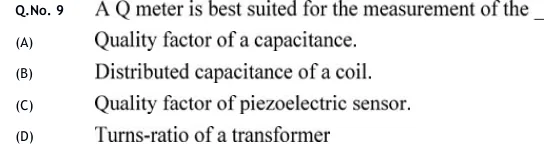
A Q meter is best suited for the measurement of the ____
- (A)
Quality factor of a capacitance.
- (B)
Distributed capacitance of a coil.
- (C)
Quality factor of piezoelectric sensor.
- (D)
Turns-ratio of a transformer

A Q meter is best suited for the measurement of the ____
Quality factor of a capacitance.
Distributed capacitance of a coil.
Quality factor of piezoelectric sensor.
Turns-ratio of a transformer
ANSWER
(B) Distributed capacitance of a coil. The Q meter finds it from two resonance settings of its tuning capacitor, at and : .
Official answer: BSource: Official answer key, GATE 2020 IN (IIT Delhi)
How a Q meter works (series resonance). The coil under test is connected in series with a calibrated variable capacitor , and a small, fixed RF voltage is injected into the loop. At resonance the voltage across the capacitor is . With held constant, a voltmeter across that is calibrated in reads the coil's quality factor directly. The instrument is designed to measure coils (inductors) at radio frequencies.
Distributed (self) capacitance is a standard Q-meter measurement. Resonate the coil at frequency with the tuning capacitor set to . Then resonate it at with the capacitor set to . Each time, the coil's distributed capacitance is in parallel with the tuning capacitor.
Apply the resonance condition at both frequencies. is the same in both cases, so it cancels:
Solving gives This needs only two readings of the capacitor dial, so the Q meter measures directly and simply. Option (B) fits.
Why not (A). A good capacitor has very low loss, so its is much higher than a coil's, and the Q meter cannot read it directly. It has to be found indirectly: resonate a standard coil first without the capacitor and then with it, and calculate the capacitor's from the small difference between two large readings. That makes the result much less accurate, so the Q meter is not best suited to this measurement.
Why not (C) and (D). A piezoelectric sensor is a capacitive, charge-generating transducer. Its quality factor describes an electromechanical resonance, not the resonance of a coil with a tuning capacitor, which is what the Q meter's circuit is built to measure. A transformer's turns ratio is found from a voltage-ratio test (a ratio meter or a ratio bridge), not from a resonance or a reading.
So, of the four options, a Q meter is best suited to measuring the distributed capacitance of a coil. Answer: (B).
KEY IDEA
A Q meter is a series-resonant circuit made of the coil under test and a calibrated tuning capacitor. At resonance , so it reads a coil's directly. Resonating the same coil at and at gives its distributed capacitance from two dial readings: .
WATCH OUT FOR
Picking (A) because the instrument is named after the quality factor. A Q meter reads a coil's Q directly. A low-loss capacitor has a much higher Q, which the meter can only find indirectly from the small difference between two readings, and that result is much less accurate. The standard "direct" uses of a Q meter are a coil's Q, its inductance and its distributed capacitance.
From the GATE 2020 IN paper. Every question of this paper · Download the full paper · All 14 Bridges questions, with notes