
IAE Academy

GATE 2025 BT Q.36: solution and answer

GATE 2025 · BTQ.36 · 2 marks · MCQ

Correctly match the Microorganisms with their respective Nutrition and energy requirement.

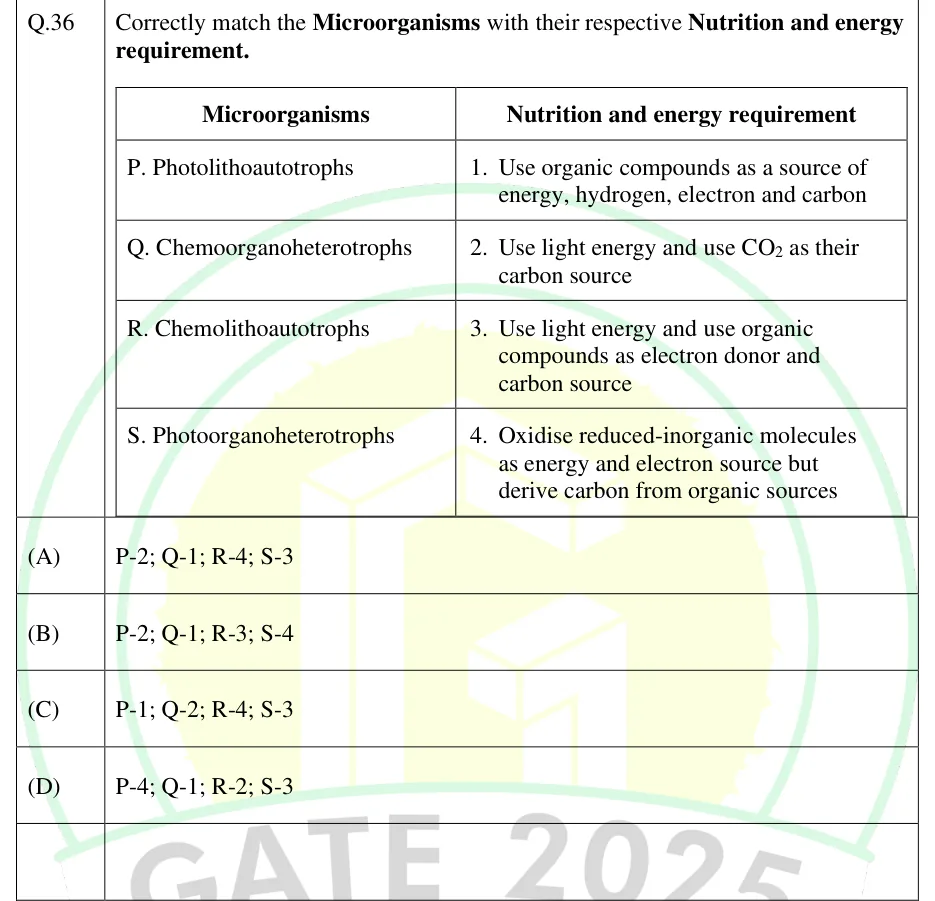
Microorganisms: P. Photolithoautotrophs; Q. Chemoorganoheterotrophs; R. Chemolithoautotrophs; S. Photoorganoheterotrophs.

Nutrition and energy requirement: 1. Use organic compounds as a source of energy, hydrogen, electron and carbon; 2. Use light energy and use CO2 as their carbon source; 3. Use light energy and use organic compounds as electron donor and carbon source; 4. Oxidise reduced-inorganic molecules as energy and electron source but derive carbon from organic sources.
GATE 2025 BT question 36: A two-column table.Tap to open full size
Figure from the GATE 2025 BT paper. It is part of the question.
Figure description

A two-column table. Left column 'Microorganisms' with rows P, Q, R, S as above. Right column 'Nutrition and energy requirement' with rows 1 to 4 as above.

  1. (A)

    P-2; Q-1; R-4; S-3

  2. (B)

    P-2; Q-1; R-3; S-4

  3. (C)

    P-1; Q-2; R-4; S-3

  4. (D)

    P-4; Q-1; R-2; S-3

Answer and solution

ANSWER

The correct matching is P-2; Q-1; R-4; S-3, which is option (A).

Official answer: ASource: Official answer key, GATE 2025 BT (IIT Roorkee)

  1. Split each name into its three prefixes. Photo- means the energy source is light and chemo- means chemical energy. Litho- means an inorganic electron donor and organo- means an organic one. Auto- means carbon comes from and hetero- means carbon comes from organic compounds.

  2. P, photolithoautotrophs. They use light energy and an inorganic electron donor, and they fix carbon from . This matches statement 2 (light energy, as the carbon source), as in cyanobacteria and plants.

  3. Q, chemoorganoheterotrophs. Organic compounds supply the energy, the electrons and hydrogen, and the carbon. This matches statement 1, as in E. coli and animals.

  4. S, photoorganoheterotrophs. They use light energy, with organic compounds as the electron donor and carbon source. This matches statement 3, as in purple non-sulfur bacteria.

  5. R, chemolithoautotrophs. They oxidise reduced inorganic molecules for energy and electrons. Of the four statements, only statement 4 describes inorganic oxidation, and statements 1, 2 and 3 are already used by P, Q and S. So R-4 is the intended pairing. Statement 4 ends with "carbon from organic sources", which is not true of a true autotroph, since chemolithoautotrophs fix . The match for R rests on the oxidation clause and on elimination.

  6. Check the options. (B) pairs R with 3, a light-based statement, and S with 4, a chemical one, so both are wrong. (C) pairs P with 1 (organic energy) and Q with 2 (light), both wrong. (D) pairs P with 4 and R with 2, which swaps the chemical and light energy sources. Only (A), P-2; Q-1; R-4; S-3, is consistent with all four matches.

KEY IDEA

Decode the nutritional-type names from their prefixes: photo-/chemo- for the energy source, litho-/organo- for the electron donor, auto-/hetero- for the carbon source. Match the three unambiguous types first, then assign the remaining statement by elimination.

WATCH OUT FOR

Rejecting statement 4 for R because it says carbon comes from organic sources, when a chemolithoautotroph fixes . Statement 4 is loosely worded, but it is the only inorganic-oxidation statement left. Another slip is swapping the light and chemical energy sources, as options (C) and (D) do.

From the GATE 2025 BT paper. Every question of this paper · Download the full paper · All 8 Microbiology questions, with notes

More Microbiology questions