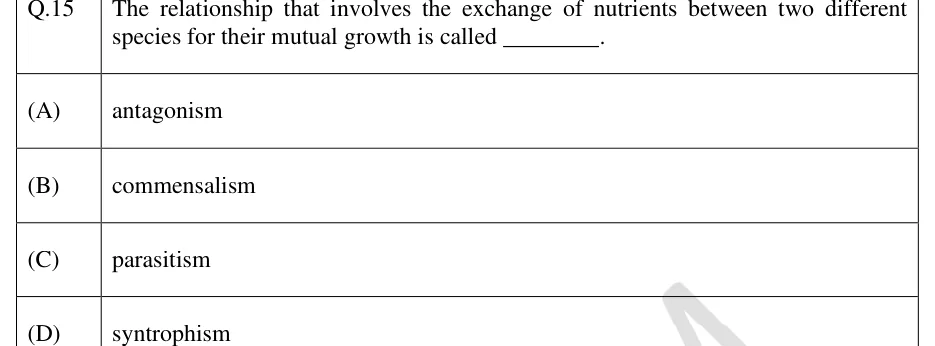
The relationship that involves the exchange of nutrients between two different species for their mutual growth is called ________.
- (A)
antagonism
- (B)
commensalism
- (C)
parasitism
- (D)
syntrophism

The relationship that involves the exchange of nutrients between two different species for their mutual growth is called ________.
antagonism
commensalism
parasitism
syntrophism
ANSWER
The relationship is called syntrophism, option (D).
Official answer: DSource: Official answer key, GATE 2024 BT (IISc Bengaluru)
The blank describes a relationship in which two different species exchange nutrients and both gain growth benefit. So the term must mean a mutually beneficial, nutrient-sharing partnership.
Option D, syntrophism: one species consumes the metabolic products of the other, such as hydrogen, formate or acetate. This keeps those products at low levels, which makes the partner's reaction thermodynamically favourable. The two species grow together, each relying on the other, so this matches the description.
Option A, antagonism: one species inhibits or harms another, for example by producing antibiotics or bacteriocins. Nothing is exchanged for mutual benefit, so it is wrong.
Option B, commensalism: one species benefits and the other is neither helped nor harmed. The benefit is one-sided, not mutual, so it is wrong.
Option C, parasitism: the parasite benefits at the host's expense. It is harmful to one partner, so it is wrong.
Only syntrophism combines nutrient exchange between species with mutual growth benefit, so the answer is (D).
KEY IDEA
Syntrophism is cross-feeding between species, where each partner's waste or product is the other's nutrient, so both grow together. Typical examples are hydrogen-producing fermenters paired with methanogens.
WATCH OUT FOR
Choosing commensalism or parasitism because they also describe two species living together. Neither involves two-way nutrient exchange for mutual growth.
From the GATE 2024 BT paper. Every question of this paper · Download the full paper · All 8 Microbiology questions, with notes