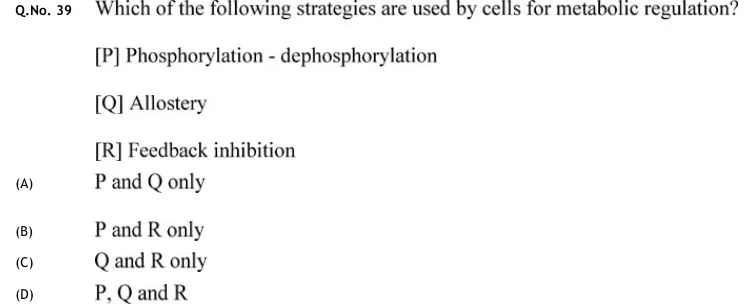
Which of the following strategies are used by cells for metabolic regulation?
[P] Phosphorylation - dephosphorylation
[Q] Allostery
[R] Feedback inhibition
- (A)
P and Q only
- (B)
P and R only
- (C)
Q and R only
- (D)
P, Q and R

Which of the following strategies are used by cells for metabolic regulation?
[P] Phosphorylation - dephosphorylation
[Q] Allostery
[R] Feedback inhibition
P and Q only
P and R only
Q and R only
P, Q and R
ANSWER
Option D: P, Q and R are all strategies cells use for metabolic regulation.
Official answer: DSource: Official answer key, GATE 2020 BT (IIT Delhi)
Cells control metabolic flux mainly at key enzymes, by changing the activity of existing enzyme molecules or the amount of enzyme. The question asks which of P, Q and R are genuine regulatory strategies.
[P] Phosphorylation-dephosphorylation is reversible covalent modification. Kinases add phosphate and phosphatases remove it, switching an enzyme between active and inactive forms, for example glycogen phosphorylase and glycogen synthase. P is used.
[Q] Allostery is the binding of an effector at a site other than the active site, which changes the enzyme's conformation and activity, for example is activated by and inhibited by and citrate. Q is used.
[R] Feedback inhibition is the end product of a pathway inhibiting an early committed enzyme, for example inhibiting aspartate transcarbamoylase. R is used. It usually works through an allosteric site, but it is still a recognised regulatory strategy in its own right.
All three are used, so options A, B and C each leave out a valid strategy and are wrong. The answer is D.
KEY IDEA
Cells regulate metabolism through covalent modification (phosphorylation-dephosphorylation), allosteric control, and feedback inhibition. All three are standard, distinct strategies.
WATCH OUT FOR
Treating feedback inhibition as the same thing as allostery and so leaving R out, or leaving out covalent modification because it is not a binding effect. Each is listed as its own strategy, so none can be dropped.
From the GATE 2020 BT paper. Every question of this paper · Download the full paper · All 13 Metabolism questions, with notes