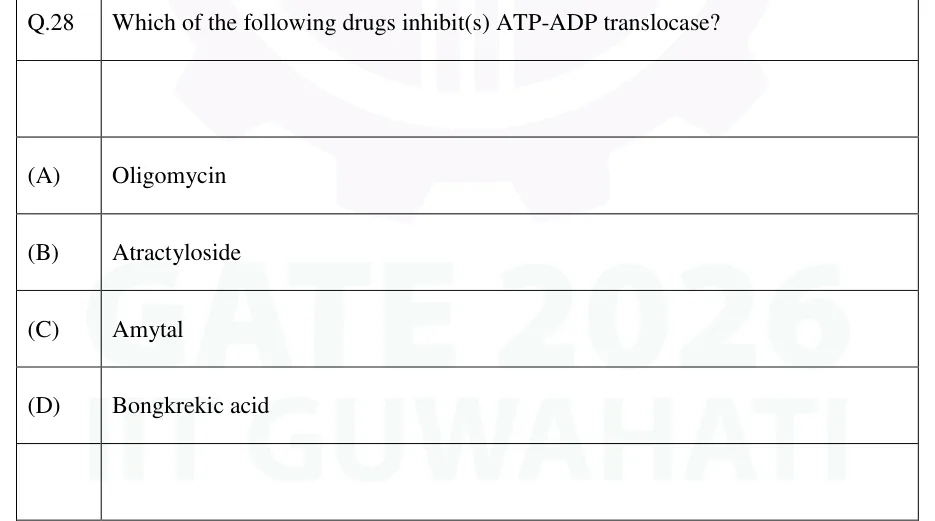
Which of the following drugs inhibit(s) ATP-ADP translocase?
- (A)
Oligomycin
- (B)
Atractyloside
- (C)
Amytal
- (D)
Bongkrekic acid

Which of the following drugs inhibit(s) ATP-ADP translocase?
Oligomycin
Atractyloside
Amytal
Bongkrekic acid
ANSWER
The ATP-ADP translocase is inhibited by atractyloside (B) and bongkrekic acid (D).
Official answer: B, DSource: Official answer key, GATE 2026 BT (IIT Guwahati)
The ATP-ADP translocase (adenine nucleotide translocase, ANT) sits in the inner mitochondrial membrane. It exports from the matrix and imports in a 1:1 antiport.
(A) Oligomycin binds the proton channel of ATP synthase and blocks proton flow through it. It does not act on the translocase, so A is wrong.
(B) Atractyloside (and its relative carboxyatractyloside) binds ANT from the cytosolic side and locks it in the cytosol-facing conformation. This stops the exchange, so B is correct.
(C) Amytal (amobarbital) is a barbiturate that inhibits Complex I (NADH dehydrogenase) and so blocks electron transfer. It does not act on the translocase, so C is wrong.
(D) Bongkrekic acid binds ANT from the matrix side and locks it in the matrix-facing conformation. This also stops the exchange, so D is correct.
The two ANT inhibitors are therefore atractyloside and bongkrekic acid, which is options B and D.
KEY IDEA
Atractyloside and bongkrekic acid both inhibit the adenine nucleotide translocase. They lock it in opposite conformations: atractyloside in the cytosol-facing one, bongkrekic acid in the matrix-facing one. Oligomycin blocks ATP synthase and amytal blocks Complex I.
WATCH OUT FOR
Treating every mitochondrial poison as a translocase inhibitor. Oligomycin (ATP synthase ) and amytal (Complex I) act on other components of oxidative phosphorylation, not on the ATP-ADP exchange.
From the GATE 2026 BT paper. Every question of this paper · Download the full paper · All 13 Metabolism questions, with notes