
IAE Academy

GATE 2025 BT Q.39: solution and answer

GATE 2025 · BTQ.39 · 2 marks · MCQ

Correctly match the type of Hypersensitivity reaction with its respective Example.
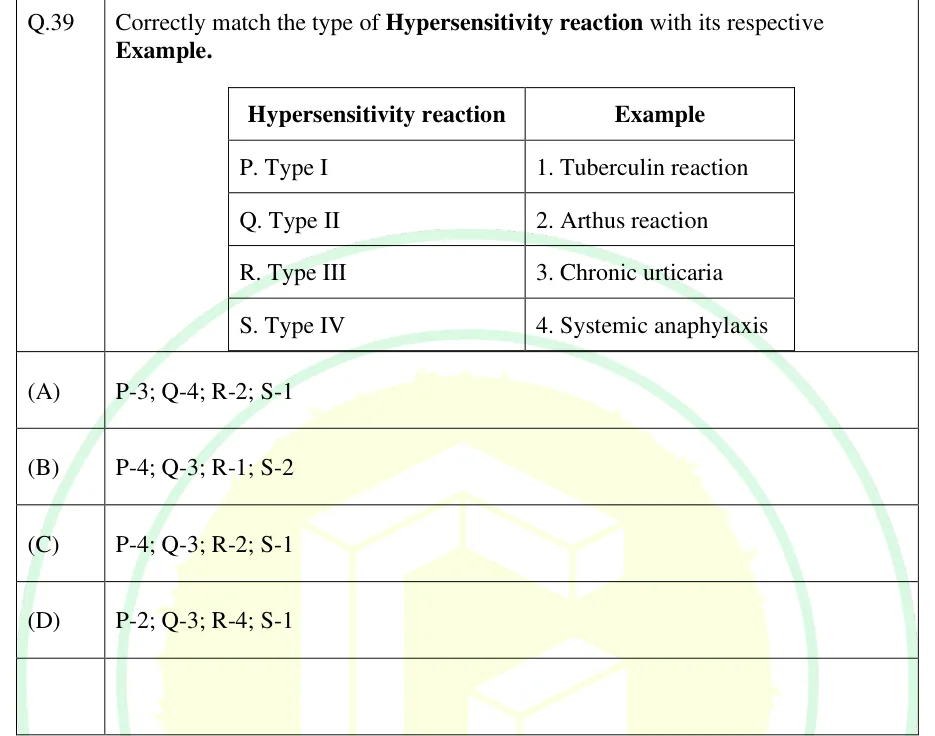
GATE 2025 BT question 39: A two-column table.Tap to open full size
Figure from the GATE 2025 BT paper. It is part of the question.
Figure description

A two-column table. Header: Hypersensitivity reaction | Example. Rows: P. Type I | 1. Tuberculin reaction; Q. Type II | 2. Arthus reaction; R. Type III | 3. Chronic urticaria; S. Type IV | 4. Systemic anaphylaxis.

  1. (A)

    P-3; Q-4; R-2; S-1

  2. (B)

    P-4; Q-3; R-1; S-2

  3. (C)

    P-4; Q-3; R-2; S-1

  4. (D)

    P-2; Q-3; R-4; S-1

Answer and solution

ANSWER

The correct matching is P-4; Q-3; R-2; S-1, which is option C.

Official answer: CSource: Official answer key, GATE 2025 BT (IIT Roorkee)

  1. Type I hypersensitivity is immediate and IgE-mediated: allergen cross-links IgE bound to mast cells, which release histamine. Its most severe form is systemic anaphylaxis, so P matches 4.

  2. Type III hypersensitivity is caused by antigen-antibody (immune) complexes that deposit in tissue, fix complement and recruit neutrophils. The Arthus reaction is the classic local example, so R matches 2.

  3. Type IV hypersensitivity is delayed-type and T-cell mediated, with no antibody involved. The tuberculin (Mantoux) reaction is the classic example, so S matches 1.

  4. Type II hypersensitivity is antibody (IgG/IgM) mediated and acts against cell-surface or tissue antigens or receptors. Chronic urticaria is often autoimmune: IgG antibodies against the high-affinity IgE receptor on mast cells, or against IgE itself, trigger degranulation. Of the four listed examples this is the one that fits Type II, and it is also the only example left after P, R and S are matched, so Q matches 3.

  5. The matching is P-4; Q-3; R-2; S-1, which is option C.

  6. Option A is wrong because it puts chronic urticaria with Type I and anaphylaxis with Type II. Option B is wrong because it pairs Type III with the tuberculin reaction and Type IV with the Arthus reaction. Option D is wrong because it pairs Type I with the Arthus reaction and Type III with systemic anaphylaxis.

KEY IDEA

Type I is IgE and mast cells (anaphylaxis). Type II is antibody against cell or receptor targets (autoimmune chronic urticaria). Type III is immune complexes (Arthus reaction). Type IV is delayed and T-cell mediated (tuberculin reaction).

WATCH OUT FOR

Chronic urticaria looks like an allergy, so it gets matched with Type I. The cause here is autoantibody against the IgE receptor or IgE, which makes it Type II. Anaphylaxis is the Type I example.

From the GATE 2025 BT paper. Every question of this paper · Download the full paper · All 7 Adaptive immunity questions, with notes

More Adaptive immunity questions