IAE Academy

GATE 2023 BT Q.36: solution and answer

GATE 2023 · BTQ.36 · 2 marks · MCQ

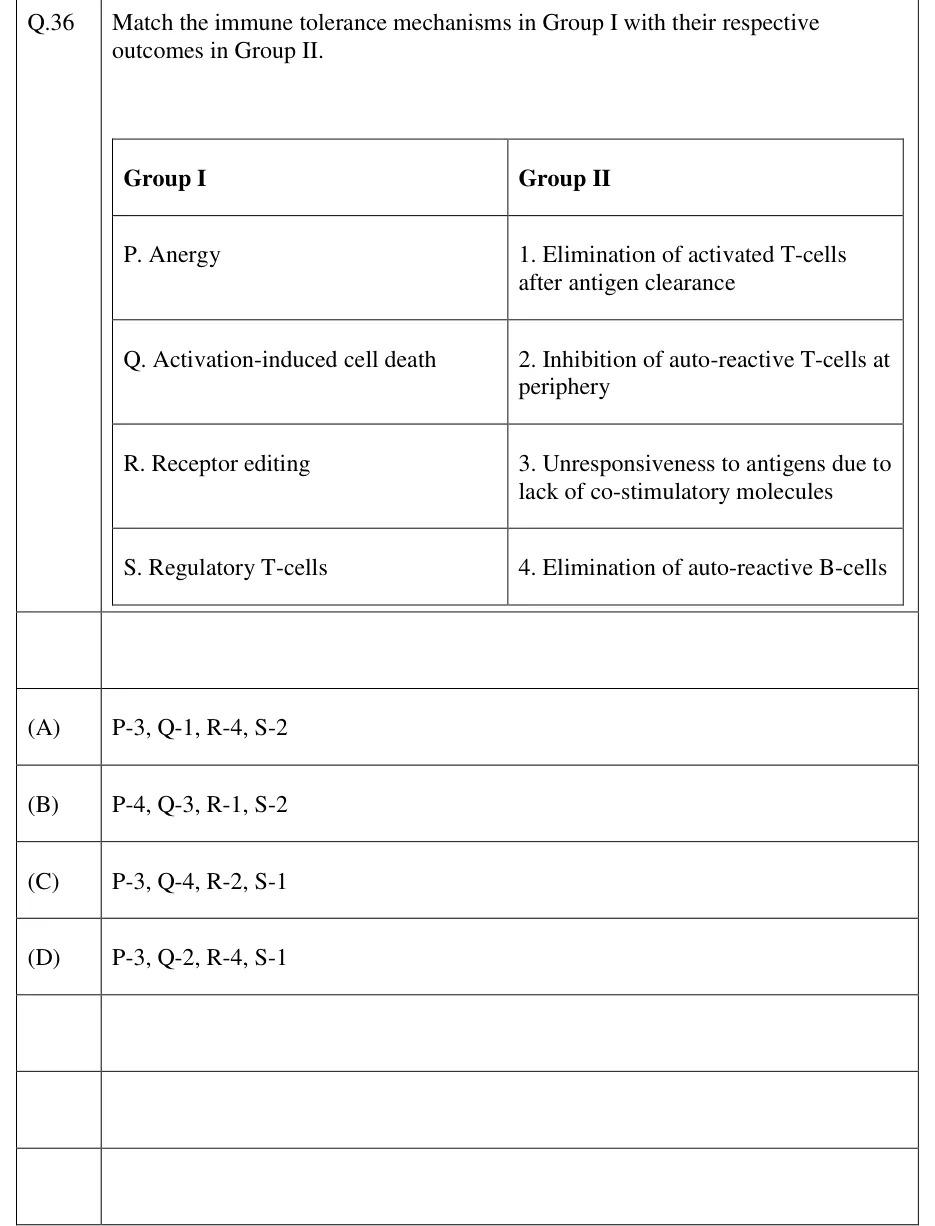
Match the immune tolerance mechanisms in Group I with their respective outcomes in Group II.

Group I: P. Anergy; Q. Activation-induced cell death; R. Receptor editing; S. Regulatory T-cells.
Group II: 1. Elimination of activated T-cells after antigen clearance; 2. Inhibition of auto-reactive T-cells at periphery; 3. Unresponsiveness to antigens due to lack of co-stimulatory molecules; 4. Elimination of auto-reactive B-cells.

  1. (A)

    P-3, Q-1, R-4, S-2

  2. (B)

    P-4, Q-3, R-1, S-2

  3. (C)

    P-3, Q-4, R-2, S-1

  4. (D)

    P-3, Q-2, R-4, S-1

See the question in the paper

Answer and solution

ANSWER

The correct matching is P-3, Q-1, R-4, S-2, which is option (A).

Official answer: ASource: Official answer key, GATE 2023 BT (IIT Kanpur)

  1. Anergy (P): a T-cell that meets antigen without co-stimulation (no CD28 signal from B7 on the antigen-presenting cell) becomes functionally unresponsive. So P matches 3.

  2. Activation-induced cell death (Q): repeated or prolonged stimulation of activated T-cells raises Fas and FasL, and the cells die by apoptosis. This removes the expanded T-cell pool once the antigen has been cleared. So Q matches 1.

  3. Receptor editing (R): a developing B-cell in the bone marrow whose receptor binds self-antigen re-expresses RAG and rearranges a new light chain. If editing fails, the B-cell is deleted. This is tolerance of auto-reactive B-cells, so R matches 4.

  4. Regulatory T-cells (S): Foxp3-positive Tregs suppress auto-reactive T-cells in the periphery, using IL-10, TGF- and CTLA-4. So S matches 2.

  5. The full matching is P-3, Q-1, R-4, S-2.

  6. Option B pairs anergy with 4 and receptor editing with 1, which is wrong. Option C pairs Q with 4 and R with 2, which is wrong. Option D pairs Q with 2 and S with 1, which is wrong. Only option A fits all four pairs.

KEY IDEA

Match each tolerance mechanism to the cell type and the stage it acts at. Anergy is a T-cell left unresponsive for lack of co-stimulation. Activation-induced cell death removes spent activated T-cells through Fas and FasL. Receptor editing acts on B-cells in the bone marrow (central tolerance). Regulatory T-cells suppress auto-reactive T-cells in the periphery.

WATCH OUT FOR

Confusing activation-induced cell death with regulatory T-cell suppression, because both limit T-cell responses in the periphery. One kills activated T-cells after the antigen is cleared. The other suppresses auto-reactive T-cells. Another slip is pairing receptor editing with a T-cell outcome, when it acts only on B-cells.

From the GATE 2023 BT paper. Every question of this paper · Download the full paper · All 7 Adaptive immunity questions, with notes

More Adaptive immunity questions