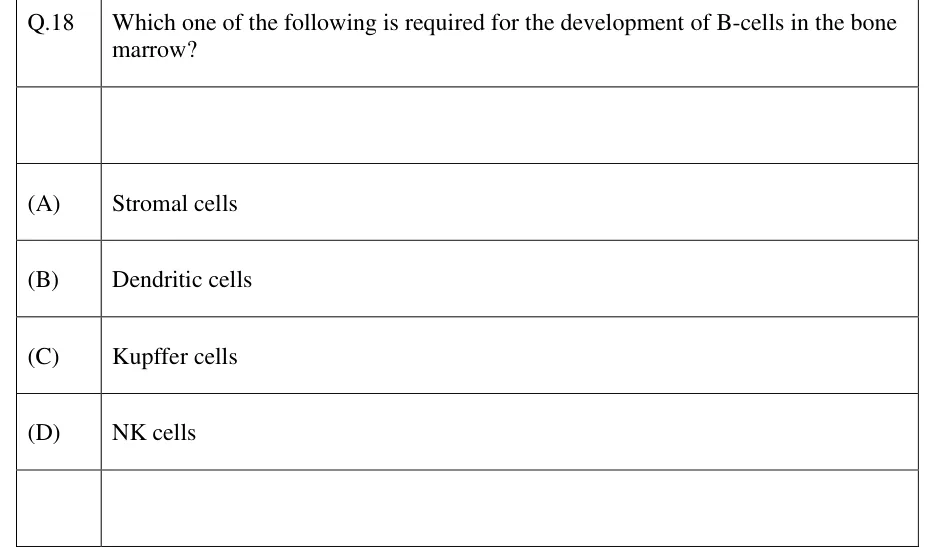
Which one of the following is required for the development of B-cells in the bone marrow?
- (A)
Stromal cells
- (B)
Dendritic cells
- (C)
Kupffer cells
- (D)
NK cells

Which one of the following is required for the development of B-cells in the bone marrow?
Stromal cells
Dendritic cells
Kupffer cells
NK cells
ANSWER
The answer is (A): stromal cells.
Official answer: ASource: Official answer key, GATE 2023 BT (IIT Kanpur)
B-cells develop from hematopoietic stem cells in the bone marrow, passing through pro-B, pre-B and immature B-cell stages before they leave for the periphery.
Each stage depends on contact with bone marrow stromal cells (reticular cells, osteoblast-lineage cells and endothelial cells). These cells supply stem cell factor (SCF), the chemokine CXCL12, IL-7 and adhesion molecules such as VCAM-1.
(A) Stromal cells: correct. They form the niche that drives B-lymphopoiesis. Without IL-7 and CXCL12, development stalls at an early progenitor stage.
(B) Dendritic cells: wrong. They are antigen-presenting cells that activate T-cells in peripheral lymphoid organs. They are not part of the marrow niche for B-cell development.
(C) Kupffer cells: wrong. These are liver-resident macrophages that clear particles and pathogens from the blood. They are not part of the B-cell niche.
(D) NK cells: wrong. They are innate cytotoxic lymphocytes that kill virus-infected and tumour cells. B-cell maturation does not need them.
Hence the answer is (A).
KEY IDEA
B-lymphopoiesis in the bone marrow depends on the stromal cell niche, which supplies IL-7, CXCL12, SCF and adhesion molecules. Dendritic cells, Kupffer cells and NK cells play no part in it.
WATCH OUT FOR
Choosing dendritic cells because they are linked to antigen presentation and B-cell responses. That role is in peripheral lymphoid organs. It is not a requirement for B-cell development in the marrow.
From the GATE 2023 BT paper. Every question of this paper · Download the full paper · All 7 Adaptive immunity questions, with notes