
IAE Academy

GATE 2022 EC Q.48: solution and answer

GATE 2022 · ECQ.48 · 2 marks · MSQ

A state transition diagram with states , , and , and transition probabilities is shown in the figure (e.g., denotes the probability of transition from state to ). For this state diagram, select the statement(s) which is/are universally true.
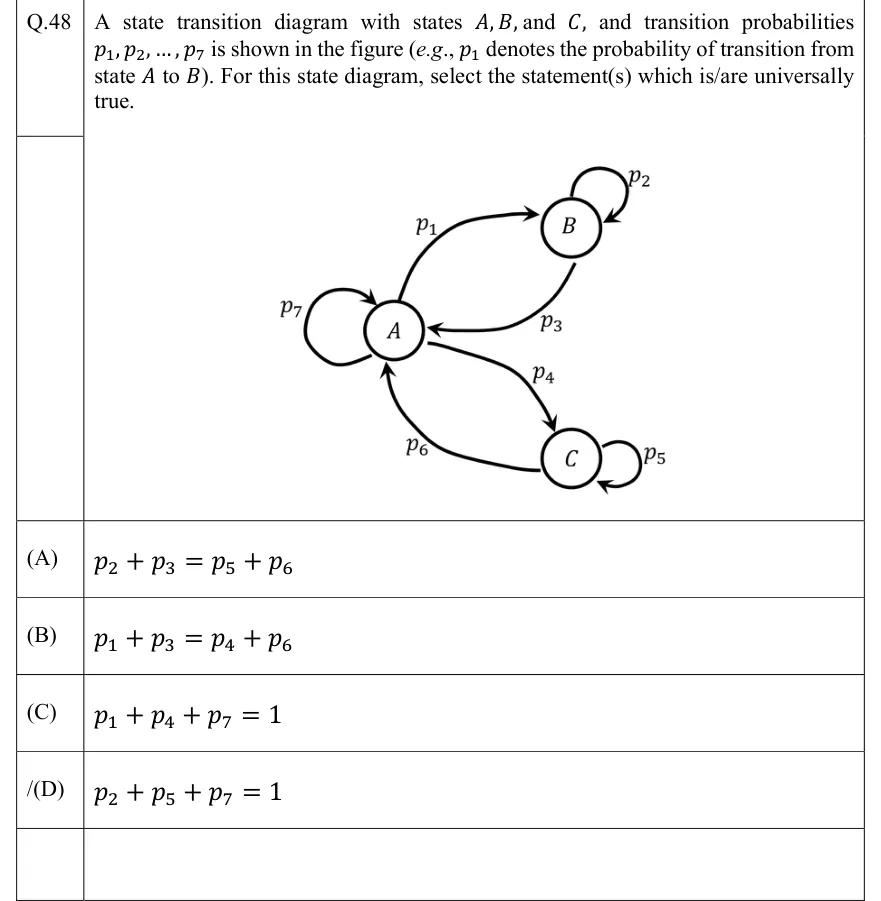
GATE 2022 EC question 48: Three circular states A, B, C.Tap to open full size
Figure from the GATE 2022 EC paper. It is part of the question.
Figure description

Three circular states A, B, C. Arrows: from A to B labelled p_1; self-loop on B labelled p_2; from B to A labelled p_3; from A to C labelled p_4; self-loop on C labelled p_5; from C to A labelled p_6; self-loop on A labelled p_7. So A has outgoing edges p_1 (to B), p_4 (to C), p_7 (to itself); B has outgoing edges p_2 (to itself), p_3 (to A); C has outgoing edges p_5 (to itself), p_6 (to A). The printed label of option D carries a stray mark, reading '/(D)'.

  1. (A)

  2. (B)

  3. (C)

  4. (D)

Answer and solution

ANSWER

(A) and (C) are universally true. The arrows leaving each state sum to 1, which gives , and . (B) and (D) each fail for a valid choice of probabilities.

Official answer: A, CSource: Official answer key, GATE 2022 EC (IIT Kharagpur)

  1. The rule. From any state the chain must go somewhere at the next step, so the probabilities on the arrows leaving a state add up to 1. (Each row of the transition matrix sums to 1.) The figure shows every allowed transition, so a move with no arrow has probability 0.

  2. Read the arrows leaving each state from the figure. Leaving A: (to B), (to C), (back to A). Leaving B: (back to B), (to A). Leaving C: (back to C), (to A).

  3. The three equations that always hold:

  4. (A) , so (A) is always true.

  5. (C) is exactly the equation for state A, so (C) is always true.

  6. (B) is false in general. Take and . All three equations hold, but while . The two sides are not equal.

  7. (D) is false in general. The three self-loops belong to three different states, so no equation ties them together. Take , with and . Every equation holds ( for A), but .

  8. So the statements that are always true are (A) and (C).

KEY IDEA

In a Markov chain's state diagram, the probabilities on the arrows leaving a state (its self-loop included) add up to 1. Only statements that follow from these per-state equations are universally true. To rule out any other statement, one valid set of numbers that breaks it is enough.

WATCH OUT FOR

Summing the arrows coming INTO a state instead of the ones leaving it. That leads to equations like for B, and it makes (B) or (D) look plausible. A second trap is marking (D) because it collects "all the self-loops". The self-loops belong to different states, so nothing forces them to add up to 1.

From the GATE 2022 EC paper. Every question of this paper · Download the full paper · All 33 Probability & statistics questions, with notes

More Probability & statistics questions