IAE Academy

GATE 2018 EC Q.11: solution and answer

GATE 2018 · ECQ.11 · 1 mark · MCQ

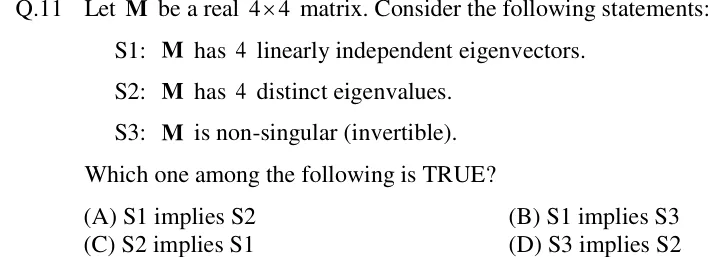
Let be a real matrix. Consider the following statements:

S1: has 4 linearly independent eigenvectors.

S2: has 4 distinct eigenvalues.

S3: is non-singular (invertible).

Which one among the following is TRUE?

  1. (A)

    S1 implies S2

  2. (B)

    S1 implies S3

  3. (C)

    S2 implies S1

  4. (D)

    S3 implies S2

See the question in the paper

Answer and solution

ANSWER

The answer is (C): S2 implies S1. When a 4×4 matrix has 4 distinct eigenvalues, it always has 4 linearly independent eigenvectors.

Official answer: CSource: Official answer key, GATE 2018 EC (IIT Guwahati)

  1. Theorem used: eigenvectors that belong to distinct eigenvalues are linearly independent. Suppose has 4 distinct eigenvalues and we pick one eigenvector for each. By the theorem these 4 eigenvectors are linearly independent, so S2 S1 and option (C) holds. (For a real matrix some of the may be complex. The theorem still applies, with the eigenvectors in .)

  2. (A) is false. Take . Every nonzero vector is an eigenvector, so the 4 standard basis vectors are 4 linearly independent eigenvectors and S1 holds. But the only eigenvalue is , repeated 4 times, so S2 fails.

  3. (B) is false. Take . The 4 standard basis vectors are linearly independent eigenvectors, all with , so S1 holds. But , so is singular and S3 fails.

  4. (D) is false. is invertible because , so S3 holds. Its eigenvalues are not distinct, so S2 fails.

  5. How S3 relates to the eigenvalues: , with eigenvalues counted by multiplicity. Invertibility therefore only says that no eigenvalue is zero. It says nothing about whether the eigenvalues are distinct or whether is diagonalisable, and diagonalisability says nothing about invertibility.

  6. Only (C) survives, and it holds for every matrix, not just for one example: distinct eigenvalues are sufficient (though not necessary) for to be diagonalisable. Answer: (C)

KEY IDEA

Eigenvectors for distinct eigenvalues are always linearly independent, so distinct eigenvalues are enough for diagonalisability. To knock out the other three options, one counterexample each is enough. shows that repeated eigenvalues can still come with a full set of eigenvectors, and that an invertible matrix can have repeated eigenvalues. shows that a full set of eigenvectors does not make a matrix invertible.

WATCH OUT FOR

Many students read the implication backwards and pick (A), treating "diagonalisable" as if it meant "distinct eigenvalues". is diagonalisable but has one eigenvalue repeated four times. Others mix up diagonalisability with invertibility and pick (B). These are unrelated properties: the zero matrix is diagonalisable (it is already diagonal) but singular.

From the GATE 2018 EC paper. Every question of this paper · Download the full paper · All 46 Linear algebra questions, with notes

More Linear algebra questions