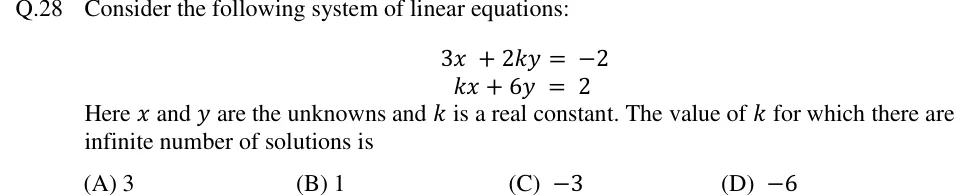
Consider the following system of linear equations:
Here and are the unknowns and is a real constant. The value of for which there are infinite number of solutions is
- (A)
- (B)
- (C)
- (D)

Consider the following system of linear equations:
Here and are the unknowns and is a real constant. The value of for which there are infinite number of solutions is
ANSWER
, option (C). At this value the two equations are the same line, so the system has infinitely many solutions.
Official answer: CSource: Official answer key, GATE 2018 IN (IIT Guwahati)
Write the system as with and . For infinitely many solutions we need , where 2 is the number of unknowns.
For the rank of to be below 2 we need :
Check : the equations become and . The left sides are the same but the right sides differ, so while . The system is inconsistent and has no solution.
Check : the equations become and . Multiplying the second by gives , which is the first equation again. So .
Rank 1 with two unknowns leaves one free variable, so the solutions are for every real . That is infinitely many solutions.
Only gives infinitely many solutions, which is option (C).
KEY IDEA
A system has infinitely many solutions only when . Put another way, the coefficient ratios must all be equal: . Here that reads , and both equalities give .
WATCH OUT FOR
Stopping at and choosing (option A). A zero determinant only rules out a unique solution. At the two lines are parallel and distinct ( against ), so the system has no solution. You have to check that the augmented matrix has the same rank before calling the solutions infinite.
From the GATE 2018 IN paper. Every question of this paper · Download the full paper · All 46 Linear algebra questions, with notes