
IAE Academy

GATE 2025 EE Q.43: solution and answer

GATE 2025 · EEQ.43 · 2 marks · MCQ

The transformer connection given in the figure is part of a balanced 3-phase circuit where the phase sequence is "abc". The primary to secondary turns ratio is 2:1. If (I_a + I_b + I_c = 0), then the relationship between I_A and I_ad will be
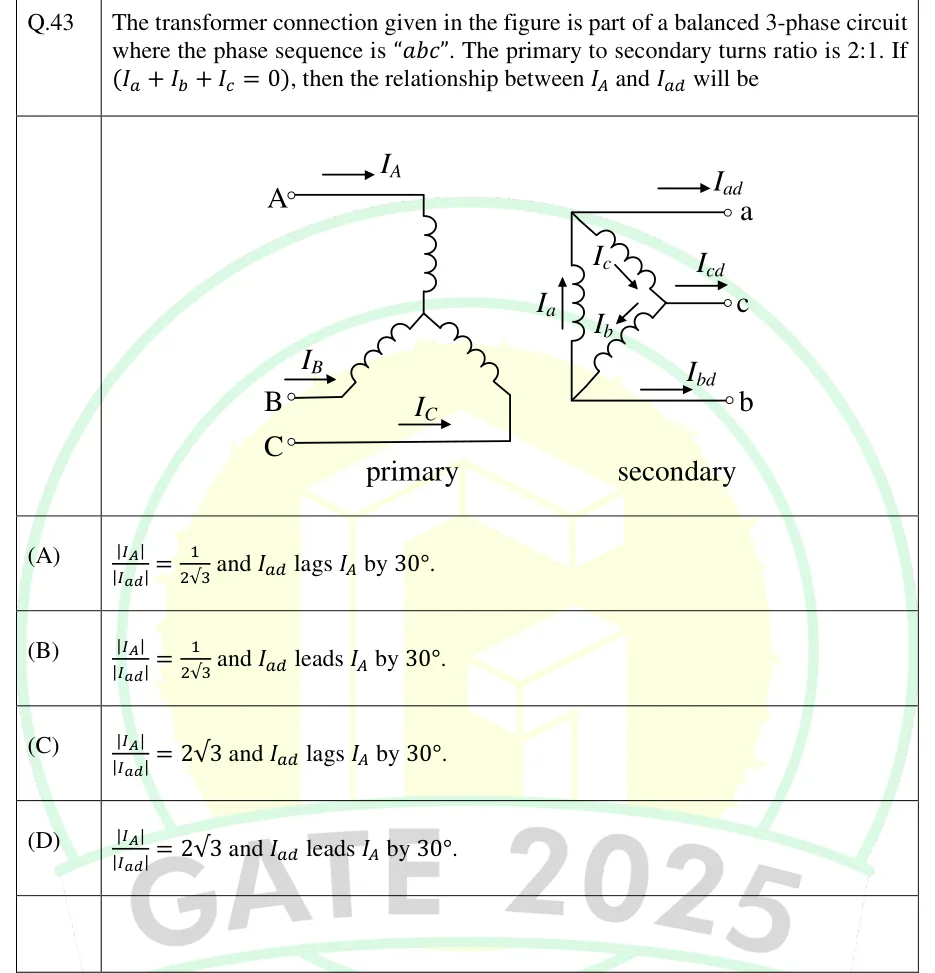
GATE 2025 EE question 43: Primary side (left): three line terminals A, B, C each feeding a winding (shown as coil loops) that connect down into a…Tap to open full size
Figure from the GATE 2025 EE paper. It is part of the question.
Figure description

Primary side (left): three line terminals A, B, C each feeding a winding (shown as coil loops) that connect down into a star-type interconnection; line currents are marked I_A (into terminal A, arrow pointing right/into the winding), I_B (into terminal B), and I_C (into terminal C), each with an arrow showing the reference direction into the transformer. Secondary side (right): a delta (triangular) winding arrangement with three output terminals a, b, c tapped from the delta corners; internal winding (phase) currents are labelled I_a (vertical arrow, left side of the triangle), I_b (diagonal arrow, lower part of the triangle) and I_c (diagonal arrow, upper part of the triangle), circulating around the closed delta loop. The external line currents drawn off the delta corners are labelled I_ad (top, leaving terminal a), I_cd (middle, leaving terminal c) and I_bd (bottom, leaving terminal b). Labels 'primary' and 'secondary' appear below each side of the figure.

  1. (A)

    |I_A|/|I_ad| = 1/(2√3) and I_ad lags I_A by 30°.

  2. (B)

    |I_A|/|I_ad| = 1/(2√3) and I_ad leads I_A by 30°.

  3. (C)

    |I_A|/|I_ad| = 2√3 and I_ad lags I_A by 30°.

  4. (D)

    |I_A|/|I_ad| = 2√3 and I_ad leads I_A by 30°.

Answer and solution

ANSWER

The correct option is (A): |I_A|/|I_ad| = 1/(2√3) and I_ad lags I_A by 30°.

Official answer: ASource: Official answer key, GATE 2025 EE (IIT Roorkee)

  1. Each primary line terminal (A, B, C) is star-connected, so the primary line current equals that leg's primary winding current. By ampere-turn balance on each core leg (turns ratio N1:N2 = 2:1), the co-labelled secondary delta-winding current has magnitude |I_a| = (N1/N2)|I_A| = 2|I_A|, and is in phase with I_A (similarly |I_b| with I_B, |I_c| with I_C).

  2. The secondary winding currents I_a, I_b, I_c satisfy I_a+I_b+I_c=0 and, with phase sequence abc, form a balanced set. Taking I_a as reference (in phase with I_A): I_a = I\angle 0^\circ,\; I_b = I\angle{-120^\circ},\; I_c = I\angle{120^\circ}, where I = 2|I_A|.

  3. From the figure, at the delta corner feeding terminal a, the winding current I_a flows into that node and I_c flows out of it, alongside the external line current I_ad. KCL at that node gives I_{ad} = I_a - I_c.

  4. Substituting the phasors: I_{ad} = I\angle 0^\circ - I\angle 120^\circ = I\left(1-\left(-\dfrac{1}{2}\right) - j\dfrac{\sqrt3}{2}\right) = I\left(\dfrac{3}{2} - j\dfrac{\sqrt3}{2}\right) = \sqrt3\,I\angle{-30^\circ}.

  5. Therefore |I_{ad}| = \sqrt3\,I = \sqrt3\,(2|I_A|) = 2\sqrt3\,|I_A|, so \dfrac{|I_A|}{|I_{ad}|} = \dfrac{1}{2\sqrt3}.

  6. Since I_{ad} is at -30^\circ relative to I_a, and I_a is in phase with I_A, I_{ad} lags I_A by 30^\circ. This matches option (A).

KEY IDEA

Match the primary star-winding current on each leg to the co-labelled secondary delta-winding current by ampere-turn balance (N1 I_primary = N2 I_secondary, in phase), then get the delta's external line current from the phasor difference of the two adjacent internal winding currents that meet at that terminal (I_ad = I_a - I_c), and finally compare magnitude and angle with the primary line current.

WATCH OUT FOR

Two common errors: (1) taking the delta line current as the sum (I_a + I_c) or as a single winding current (just I_a) instead of the correct phasor difference of the two windings meeting at that corner, which changes both the √3 factor and the ±30° shift; (2) getting the sign of the 30° shift backwards by mislabelling which winding is "incoming" vs "outgoing" at the corner, turning a lag into a lead (confusing options A and B, or C and D).

From the GATE 2025 EE paper. Every question of this paper · Download the full paper · All 14 Transformers questions, with notes

More Transformers questions