
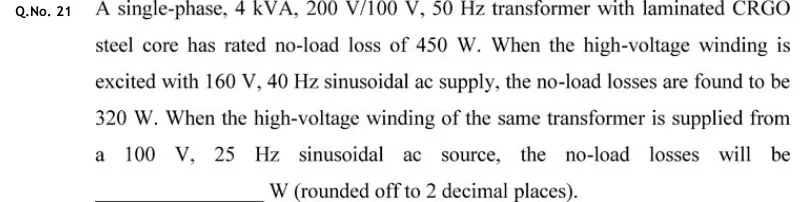
A single-phase, 4 kVA, 200 V/100 V, 50 Hz transformer with laminated CRGO steel core has rated no-load loss of 450 W. When the high-voltage winding is excited with 160 V, 40 Hz sinusoidal ac supply, the no-load losses are found to be 320 W. When the high-voltage winding of the same transformer is supplied from a 100 V, 25 Hz sinusoidal ac source, the no-load losses will be _______ W (rounded off to 2 decimal places).
GATE 2020 EE Q.21: solution and answer
Answer and solution
ANSWER
The no-load loss at 100 V, 25 Hz is 162.50 W.
Official answer: 162.41 to 162.59Source: Official answer key, GATE 2020 EE (IIT Delhi)
Since for a fixed winding, the peak flux density obeys . Check the ratio in all three given conditions: rated ; test ; target . All three give the same ratio, so is the SAME constant value in each case.
With held constant, hysteresis loss and eddy current loss — the -dependence in each loss law contributes only an unchanging multiplicative factor, so only the frequency dependence survives when comparing conditions.
Let the rated-condition () losses be and , so .
At , the frequency ratio relative to rated is , so
Substituting :
At (same ), the frequency ratio relative to rated is :
Total no-load loss .
KEY IDEA
No-load (core) loss splits into hysteresis loss (∝ f · B_m^n) and eddy current loss (∝ f² · B_m²). Since E = 4.44 f N B_m A, the flux density B_m depends only on the ratio V/f. Whenever V/f is held at the same value across different test conditions, B_m stays constant, so the two loss components reduce to simple functions of frequency alone: P_h ∝ f and P_e ∝ f². This lets two known (V, f, loss) data points fix P_h and P_e at a reference condition, from which the loss at any other same-(V/f) condition follows by scaling.
WATCH OUT FOR
Forgetting to check that V/f is actually the same in all three conditions before dropping B_m from the proportionality — if V/f changed, B_m would change too and P_h ∝ f alone (or P_e ∝ f² alone) would no longer hold. A second common slip is mixing up which loss scales as f versus f² (swapping hysteresis and eddy current), or using absolute frequencies in the ratio instead of the ratio relative to the condition where P_h, P_e were computed.
From the GATE 2020 EE paper. Every question of this paper · Download the full paper · All 14 Transformers questions, with notes
More Transformers questions
- GATE 2018 EE Q.1 · MCQ · 1 markA single-phase 100 kVA, 1000 V / 100 V, 50 Hz transformer has a voltage drop of 5% across its series…
- GATE 2018 EE Q.51 · NAT · 2 marksA 3-phase 900 kVA, 3 kV / √3 kV (Δ/Y), 50 Hz transformer has primary (high voltage side) resistance per…
- GATE 2026 EE Q.17 · MCQ · 1 markA 15 kVA, 1100 V/220 V, single-phase two-winding transformer is configured as a 1.32 kV/1.1 kV…
- GATE 2026 EE Q.31 · MSQ · 1 markA 220V/12V single-phase transformer is designed for use in India and rated 100 VA at 50 Hz.