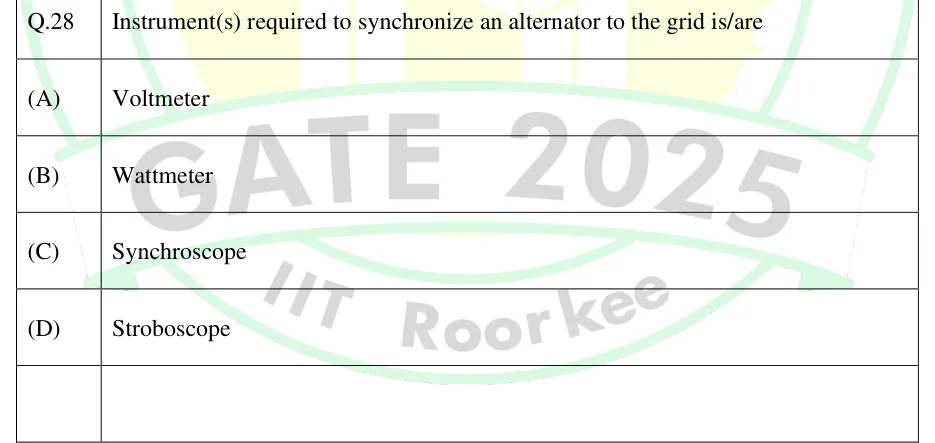
Instrument(s) required to synchronize an alternator to the grid is/are
- (A)
Voltmeter
- (B)
Wattmeter
- (C)
Synchroscope
- (D)
Stroboscope

Instrument(s) required to synchronize an alternator to the grid is/are
Voltmeter
Wattmeter
Synchroscope
Stroboscope
ANSWER
The correct options are (A) Voltmeter and (C) Synchroscope.
Official answer: A, CSource: Official answer key, GATE 2025 EE (IIT Roorkee)
Synchronizing conditions: to connect an alternator to the grid without transients, four conditions must be satisfied at the moment the breaker closes — (i) equal RMS voltage magnitude, (ii) equal frequency, (iii) same phase sequence, and (iv) zero phase-angle difference between the incoming machine and the bus.
Voltmeter: connected across the incoming alternator and the bus (directly, or via the double-voltmeter/synchronizing-lamp arrangement), a voltmeter is used to confirm condition (i), equal voltage magnitude, before attempting synchronization.
Synchroscope: connected across the breaker (fed from the incoming machine's and the bus's potential transformers), a synchroscope is an instrument whose pointer position and direction of rotation directly indicate the phase-angle difference and whether the incoming machine is running fast or slow relative to the bus. The operator closes the breaker exactly when the pointer crosses the 'in-phase' (12 o'clock) position, which is the standard way of satisfying conditions (ii)-(iv) together.
Wattmeter: measures real power flow, a quantity that is only meaningful once the machine is already connected to the bus; it gives no information needed to decide when to close the breaker, so option (B) is not a synchronizing instrument.
Stroboscope: used to measure or observe mechanical rotational speed via a flashing light against a marked rotating part; it is not part of the standard electrical synchronizing (breaker-closing) procedure for an alternator, so option (D) is not a synchronizing instrument.
Hence the instruments required to synchronize an alternator to the grid are the Voltmeter and the Synchroscope — options (A) and (C).
KEY IDEA
Synchronizing an alternator to an infinite bus/grid requires matching (i) voltage magnitude, (ii) frequency, (iii) phase sequence, and (iv) phase angle (zero at the instant of closing the breaker). A voltmeter (or double-voltmeter method) checks voltage magnitude equality, and a synchroscope directly displays the phase-angle/slip condition, telling the operator exactly when to close the breaker.
WATCH OUT FOR
Picking the wattmeter because it seems like a natural "power system" instrument — but real/reactive power flow is only meaningful after paralleling, not during the synchronizing check itself. Similarly, confusing the stroboscope (used for measuring rotational/mechanical speed by a flashing-light effect) with the synchroscope (an electrical instrument that indicates phase difference/slip between two AC systems) is a common name-similarity trap.
From the GATE 2025 EE paper. Every question of this paper · Download the full paper · All 11 Synchronous machines questions, with notes