IAE Academy

GATE 2020 EE Q.7: solution and answer

GATE 2020 · EEQ.7 · 1 mark · MCQ

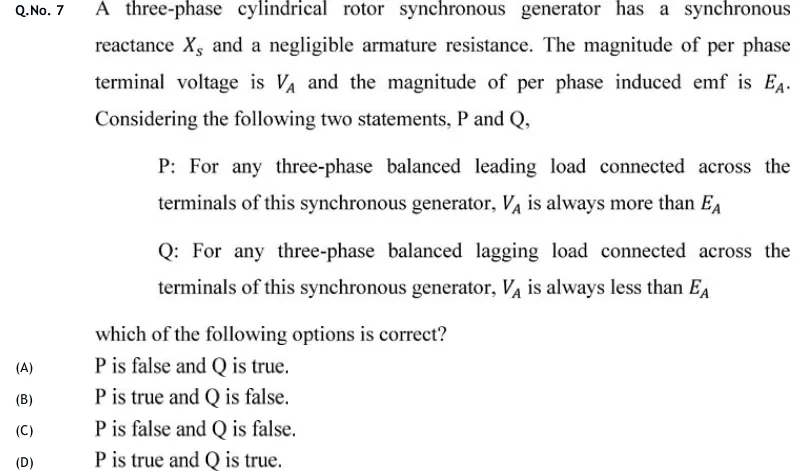
A three-phase cylindrical rotor synchronous generator has a synchronous reactance and a negligible armature resistance. The magnitude of per phase terminal voltage is and the magnitude of per phase induced emf is . Considering the following two statements, P and Q,

P: For any three-phase balanced leading load connected across the terminals of this synchronous generator, is always more than

Q: For any three-phase balanced lagging load connected across the terminals of this synchronous generator, is always less than

which of the following options is correct?

  1. (A)

    P is false and Q is true.

  2. (B)

    P is true and Q is false.

  3. (C)

    P is false and Q is false.

  4. (D)

    P is true and Q is true.

See the question in the paper

Answer and solution

ANSWER

Option (A) — P is false and Q is true.

Official answer: ASource: Official answer key, GATE 2020 EE (IIT Delhi)

  1. Per-phase, neglecting armature resistance, the generator's phasor equation is . Take as the reference phasor and let the armature current be , with for a leading load and for a lagging load.

  2. Resolving the drop: , so

  3. Taking the magnitude squared:

  4. Lagging load: put with . Then , so for every lagging current, since both terms on the right are positive. Hence , i.e. is always less than , for every lagging load — statement Q is TRUE.

  5. Leading load: , so whose sign depends on whether is greater than or less than — it is not fixed.

  6. In particular, whenever the leading current and angle are such that (for instance, a small leading angle keeps small, so even a moderate leading current satisfies this), the right side is positive, giving , i.e. — a direct counterexample to statement P.

  7. Since P claims is ALWAYS more than for every leading load, and a leading-load case exists where , statement P is FALSE.

  8. Therefore P is false and Q is true — option (A).

KEY IDEA

For a cylindrical-rotor synchronous generator with negligible armature resistance, . Writing this out for a load current at angle from gives . For a lagging load () this quantity is a sum of two positive terms and is always positive, so unconditionally. For a leading load () the sign depends on the relative size of and , so no unconditional relation holds — an "always" claim for leading loads must be false.

WATCH OUT FOR

Over-generalizing the familiar rule of thumb "lagging loads reduce terminal voltage, leading loads raise it" into a universal statement for BOTH directions. The rule is unconditionally true only for lagging loads (Q); for leading loads (P), whether exceeds depends on the magnitude of the leading current relative to , so treating P as always true (picking option D) is the typical error. A second common mistake is a sign slip when resolving , which can flip which of P/Q comes out true.

From the GATE 2020 EE paper. Every question of this paper · Download the full paper · All 11 Synchronous machines questions, with notes

More Synchronous machines questions