IAE Academy

GATE 2024 EE Q.40: solution and answer

GATE 2024 · EEQ.40 · 2 marks · MCQ

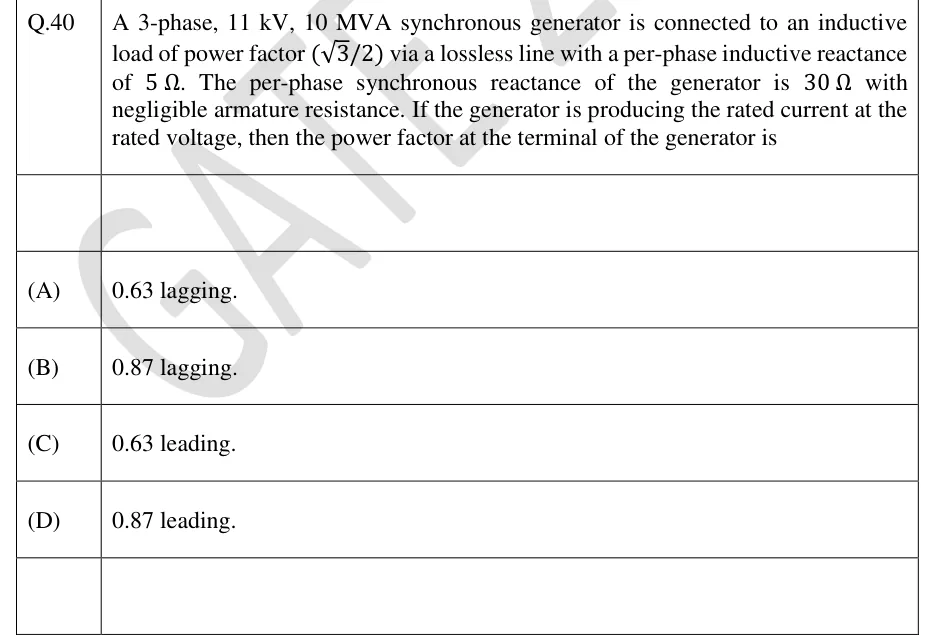
A 3-phase, 11 kV, 10 MVA synchronous generator is connected to an inductive load of power factor () via a lossless line with a per-phase inductive reactance of . The per-phase synchronous reactance of the generator is with negligible armature resistance. If the generator is producing the rated current at the rated voltage, then the power factor at the terminal of the generator is

  1. (A)

    0.63 lagging.

  2. (B)

    0.87 lagging.

  3. (C)

    0.63 leading.

  4. (D)

    0.87 leading.

See the question in the paper

Answer and solution

ANSWER

The power factor at the generator terminal is 0.63 lagging.

Official answer: ASource: Official answer key, GATE 2024 EE (IISc Bengaluru)

  1. Rated phase voltage: ; rated current: .

  2. Take the current as reference, . The load power factor is lagging, so for an inductive (lagging) load the load voltage leads the current by : , with magnitude unknown.

  3. Since the line is lossless (purely reactive, ), the generator terminal voltage is .

  4. The generator is at its rated terminal (phase) voltage, so . Writing in rectangular form: , .

  5. Applying the magnitude condition: (the negative root is rejected as unphysical).

  6. Generator terminal voltage components: , .

  7. Angle of the terminal voltage relative to the current: .

  8. Generator terminal power factor . Since the terminal voltage leads the current (positive angle), the current lags the voltage, so the power factor is lagging.

KEY IDEA

When a generator supplies a lagging load through a purely reactive line, the terminal voltage phasor is found by adding the line's reactive drop () to the load voltage phasor; since only the terminal current and terminal voltage magnitude are given, the generator's own synchronous reactance (30 Ω) is irrelevant to finding the terminal power factor — it would only be needed to find the internal EMF.

WATCH OUT FOR

Using the generator's synchronous reactance (30 Ω) instead of, or in addition to, the line reactance (5 Ω) when computing the terminal voltage phasor — the synchronous reactance relates internal EMF to terminal voltage and plays no role in a question that already gives both rated terminal voltage and rated current.

From the GATE 2024 EE paper. Every question of this paper · Download the full paper · All 11 Synchronous machines questions, with notes

More Synchronous machines questions