
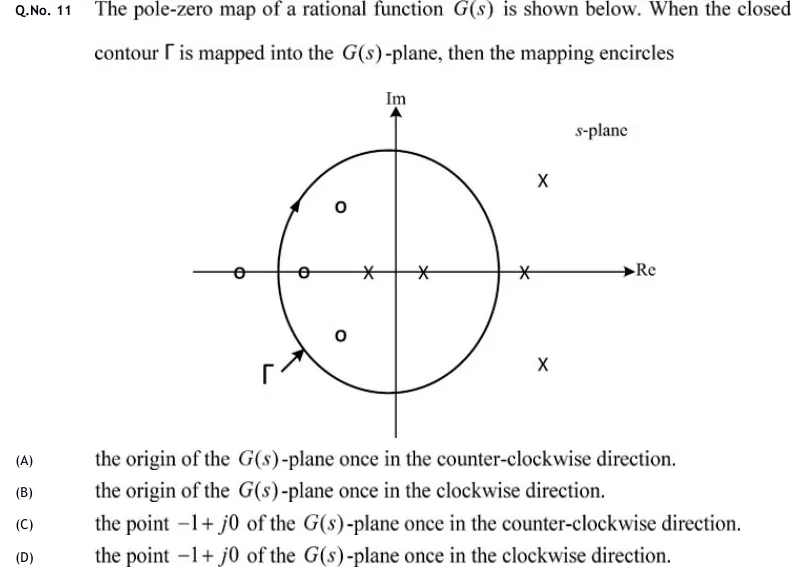
The pole-zero map of a rational function is shown below. When the closed contour is mapped into the -plane, then the mapping encircles
 Tap to open full size
Figure description
An s-plane with a horizontal axis labelled Re and a vertical axis labelled Im. A closed, roughly circular contour labelled Γ is centred near the origin. The only arrowhead on the curve is on its upper-left arc and points up and to the right along the curve, so Γ is traversed clockwise. The short arrow at the lower left runs from the label Γ to the curve and marks the label only. Inside Γ are one zero (o) on the negative real axis just inside the left edge of the contour, a complex-conjugate pair of zeros in the left half-plane (upper-left and lower-left), and two poles (x) on the real axis, one on the negative side between that zero and the origin and one on the positive side close to the origin. Outside Γ are one zero on the negative real axis to the left of the contour, one pole on the positive real axis just to the right of the contour's right edge, and a complex-conjugate pair of poles in the right half-plane (upper-right and lower-right). No pole or zero lies on the contour.
- (A)
the origin of the -plane once in the counter-clockwise direction.
- (B)
the origin of the -plane once in the clockwise direction.
- (C)
the point of the -plane once in the counter-clockwise direction.
- (D)
the point of the -plane once in the clockwise direction.