
IAE Academy

GATE 2024 EE Q.58: solution and answer

GATE 2024 · EEQ.58 · 2 marks · NAT

Consider the stable closed-loop system shown in the figure. The asymptotic Bode magnitude plot of has a constant slope of dB/decade at least till rad/sec with the gain crossover frequency being rad/sec. The asymptotic Bode phase plot remains constant at at least till rad/sec. The steady-state error of the closed-loop system for a unit ramp input is ________ (rounded off to 2 decimal places).
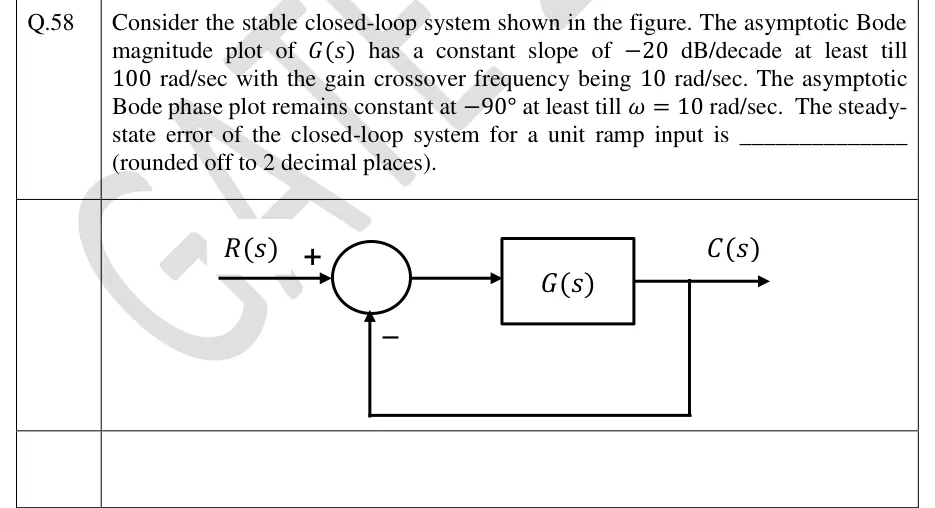
GATE 2024 EE question 58: Unity negative feedback loop.Tap to open full size
Figure from the GATE 2024 EE paper. It is part of the question.
Figure description

Unity negative feedback loop. Input R(s) enters a summing junction with a + sign; the output of the junction feeds a single forward block G(s) whose output is C(s). C(s) is taken back directly (gain 1) to the summing junction with a - sign. No other blocks.

Answer and solution

ANSWER

The steady-state error for a unit ramp input is .

Official answer: 0.09 to 0.11Source: Official answer key, GATE 2024 EE (IISc Bengaluru)

  1. Read the low-frequency asymptote. The asymptotic magnitude has one constant slope of dB/decade from low frequency up to at least rad/s, and the asymptotic phase stays at up to at least rad/s. So has exactly one pole at the origin and no corner frequency below rad/s. In this band , which makes it a type-1 system.

  2. Use the gain crossover to find . The crossover rad/s lies inside the dB/dec band, so

  3. Velocity error constant. For a type-1 system, . Graphically, is the frequency where the initial dB/dec line (or its extension) crosses dB. Here that line is still the actual asymptote at rad/s, so equals the gain crossover frequency, .

  4. Ramp error for unity feedback. The question says the closed loop is stable, so the final value theorem applies:

KEY IDEA

A dB/dec asymptote with phase that starts at low frequency means one integrator, so the system is type 1. For a type-1 system, the initial dB/dec line crosses dB at . Here nothing changes the slope before rad/s, so that crossing is the gain crossover itself, and . For unity feedback, .

WATCH OUT FOR

Setting is only valid because the slope is still dB/dec at crossover. If a corner frequency lay below , would come from the dB crossing of the extended initial line, not from . Other slips are using the type-0 formula (which gives only by coincidence and uses the wrong reasoning), or answering that the error is zero or infinite without first reading the system type from the phase.

From the GATE 2024 EE paper. Every question of this paper · Download the full paper · All 27 Bode & margins questions, with notes

More Bode & margins questions