
IAE Academy

GATE 2024 EE Q.59: solution and answer

GATE 2024 · EEQ.59 · 2 marks · NAT

Consider the stable closed-loop system shown in the figure. The magnitude and phase values of the frequency response of are given in the table. The value of the gain for a phase margin is ________ (rounded off to 2 decimal places).

| in rad/sec | Magnitude in dB | Phase in degrees |
|---|---|---|
| 0.5 | | |
| 1.0 | | |
| 2.0 | | |
| 10.0 | | |
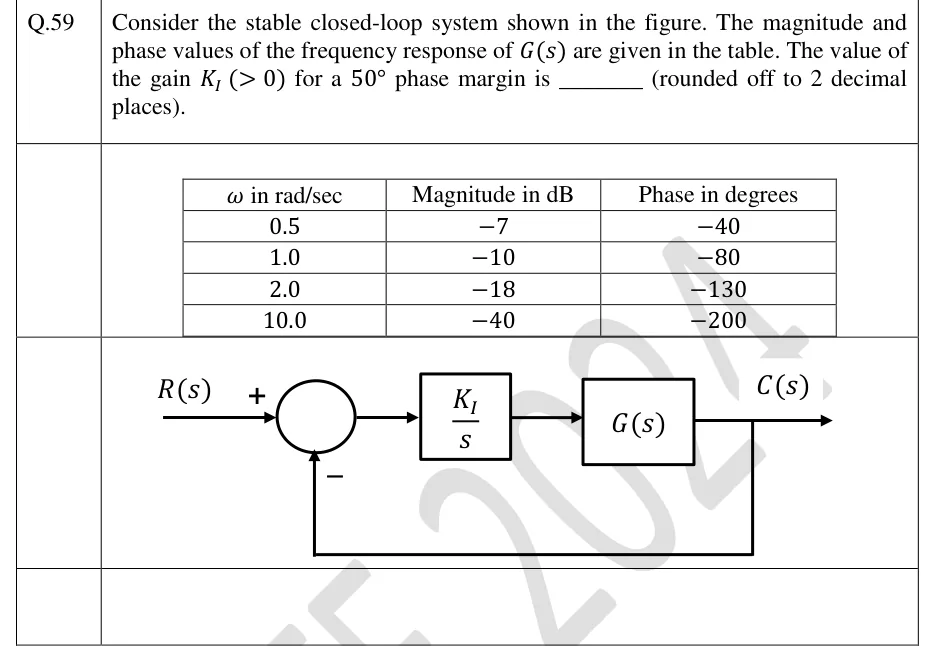
GATE 2024 EE question 59: Unity negative feedback loop.Tap to open full size
Figure from the GATE 2024 EE paper. It is part of the question.
Figure description

Unity negative feedback loop. R(s) enters a summing junction with a + sign; the feedback enters the same junction from below with a - sign. The junction output goes to a block (K_I)/(s), which feeds a block G(s) in cascade. The output of G(s) is C(s), and C(s) is fed back directly (unity gain, no block) to the negative input of the summing junction. The frequency-response table of G(s) is printed above the diagram.

Answer and solution

ANSWER

.

Official answer: 1.11 to 1.13Source: Official answer key, GATE 2024 EE (IISc Bengaluru)

  1. Open-loop transfer function (unity negative feedback): . On this gives and . In decibels: .

  2. Phase margin definition: , where is the gain crossover frequency (, i.e. 0 dB). For we need .

  3. So . The table gives exactly this phase at , so no interpolation is needed: , where . Changing scales the magnitude only, not the phase, so this frequency is fixed and must be chosen to make it the crossover.

  4. Gain crossover condition :

  5. Solve:

  6. Check stability with this (). At : , . At : , . So the phase crossover () lies between 1 and 2 rad/s, where is already below . The gain margin is positive and the phase margin is , so the loop is stable, as the question states.

  7. Rounded to 2 decimal places: .

KEY IDEA

The integrator adds a fixed at every frequency, and changes only the magnitude, never the phase. So you find the gain crossover frequency from the phase alone: , which the table gives at . Then you pick so that at that frequency: .

WATCH OUT FOR

Forgetting the integrator's own and . Taking gives , which is wrong. Dropping the factor gives , and that is wrong too. Another slip is turning into a ratio with , the power formula, instead of .

From the GATE 2024 EE paper. Every question of this paper · Download the full paper · All 27 Bode & margins questions, with notes

More Bode & margins questions