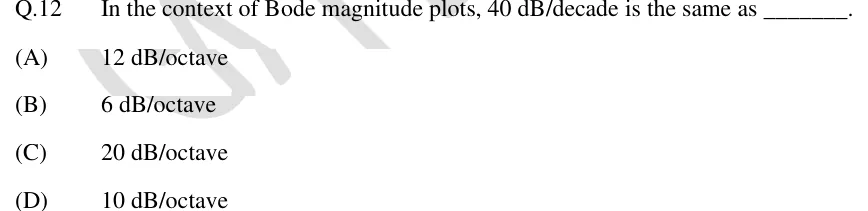
In the context of Bode magnitude plots, 40 dB/decade is the same as _______.
- (A)
12 dB/octave
- (B)
6 dB/octave
- (C)
20 dB/octave
- (D)
10 dB/octave

In the context of Bode magnitude plots, 40 dB/decade is the same as _______.
12 dB/octave
6 dB/octave
20 dB/octave
10 dB/octave
ANSWER
(A) 12 dB/octave. A decade holds octaves, so .
Official answer: ASource: Official answer key, GATE 2024 EC (IISc Bengaluru)
Definitions. A decade is a frequency ratio of and an octave is a frequency ratio of . On a Bode plot the horizontal axis is , so a slope in dB per decade becomes dB per octave once you know how many octaves fit in one decade.
Octaves in one decade.
Convert the slope. Put the other way round, one octave is decade, so the change over one octave is .
Check with poles. A slope of is what 2 poles (or 2 zeros) give well above their corner frequency. Each one adds per octave, so 2 of them add .
Only option (A), , matches.
KEY IDEA
Remember that , because . Every slope is a whole multiple of that pair, so (two poles or zeros) is .
WATCH OUT FOR
Some students divide by 10/2 = 5 and get 8 dB/octave. That treats the axis as linear, when it is logarithmic: a decade is octaves, not 5. Others pick 20 dB/octave (C) because they remember \"20\" from the one-pole slope and forget that the unit is per decade there. A third error is halving the slope to 6 dB/octave (B), which is the value for 20 dB/decade, not 40.
From the GATE 2024 EC paper. Every question of this paper · Download the full paper · All 27 Bode & margins questions, with notes