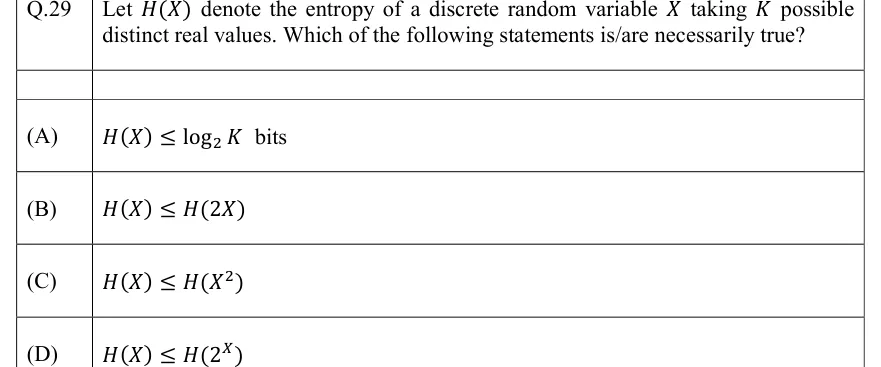
Let denote the entropy of a discrete random variable taking possible distinct real values. Which of the following statements is/are necessarily true?
- (A)
bits
- (B)
- (C)
- (D)

Let denote the entropy of a discrete random variable taking possible distinct real values. Which of the following statements is/are necessarily true?
bits
ANSWER
The necessarily true statements are (A), (B) and (D).
Official answer: A, B, DSource: Official answer key, GATE 2022 EC (IIT Kharagpur)
Entropy depends only on the probability masses of , not on the values it takes. If is one-to-one on the values of , then has the same set of masses, so . If is many-to-one, some values merge and their masses add, so .
(A) By Jensen's inequality for the concave function : , with equality for the uniform distribution. So bits always. True.
(B) is one-to-one on the real line, so the masses are unchanged and . Hence holds (with equality). True.
(C) is many-to-one when takes both and . Take with probability each: bit, but with certainty, so . Then fails, so the statement is not necessarily true.
(D) is strictly increasing, hence one-to-one, so and holds. True.
Statements that are necessarily true: A, B and D.
KEY IDEA
Entropy depends only on the probability masses. A one-to-one function of leaves unchanged, a many-to-one function can only lower it, and for outcomes.
WATCH OUT FOR
Treating like or . Squaring merges the values and , so can be smaller than . The inequality is therefore not guaranteed.
From the GATE 2022 EC paper. Every question of this paper · Download the full paper · All 9 Information theory questions, with notes