IAE Academy

GATE 2026 EC Q.55: solution and answer

GATE 2026 · ECQ.55 · 2 marks · MSQ

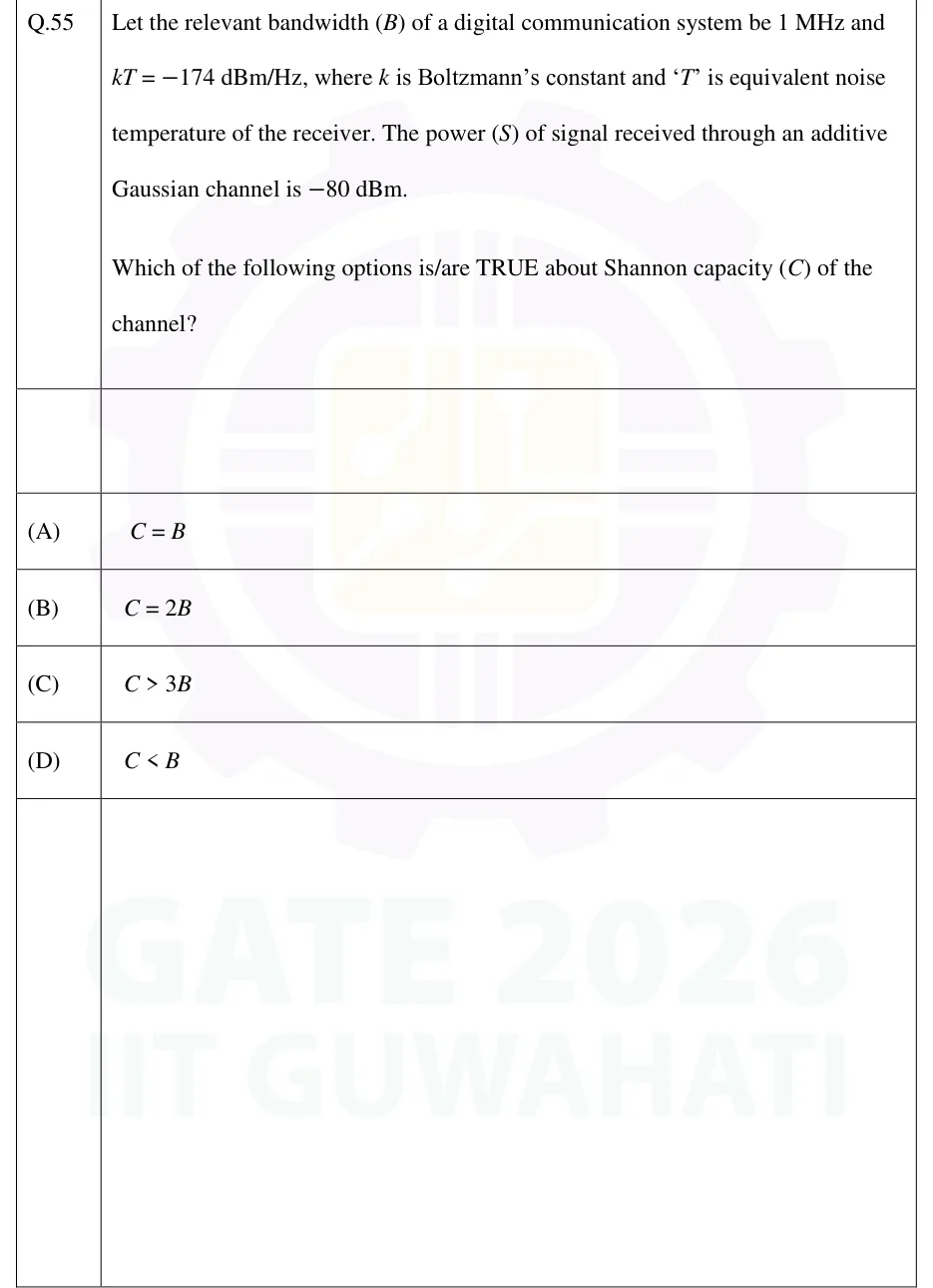
Let the relevant bandwidth () of a digital communication system be 1 MHz and dBm/Hz, where is Boltzmann's constant and 'T' is equivalent noise temperature of the receiver. The power () of signal received through an additive Gaussian channel is dBm. Which of the following options is/are TRUE about Shannon capacity () of the channel?

  1. (A)

  2. (B)

  3. (C)

  4. (D)

See the question in the paper

Answer and solution

ANSWER

Only option (C) is true: .

Official answer: CSource: Official answer key, GATE 2026 EC (IIT Guwahati)

  1. Take the given as the one-sided noise power spectral density (the question gives directly, so no extra factor of 2 is applied). Then the noise power in the bandwidth is .

  2. In decibels: .

  3. The received signal power is , so .

  4. Convert to a ratio: .

  5. Shannon capacity of the band-limited AWGN channel: .

  6. , so .

  7. Check the options. (A) : false, since . (B) : false. (C) : true, since . (D) : false.

  8. Even if were read as (so ), the SNR would drop by 3 dB to 31 dB and , still above . The result does not depend on this convention.

KEY IDEA

Convert the noise PSD in dBm/Hz to noise power in the band by adding , subtract in dB to get the SNR (34 dB), then apply . At this high SNR the capacity is many times .

WATCH OUT FOR

Forgetting the bandwidth term dB, which gives an SNR of dB instead of dB. Another slip is treating the SNR in dB as a linear ratio, or taking and then confusing dB with ratio. Another is reading "" as needing a precise value, when any SNR above 7 (8.5 dB) is enough.

From the GATE 2026 EC paper. Every question of this paper · Download the full paper · All 9 Information theory questions, with notes

More Information theory questions