
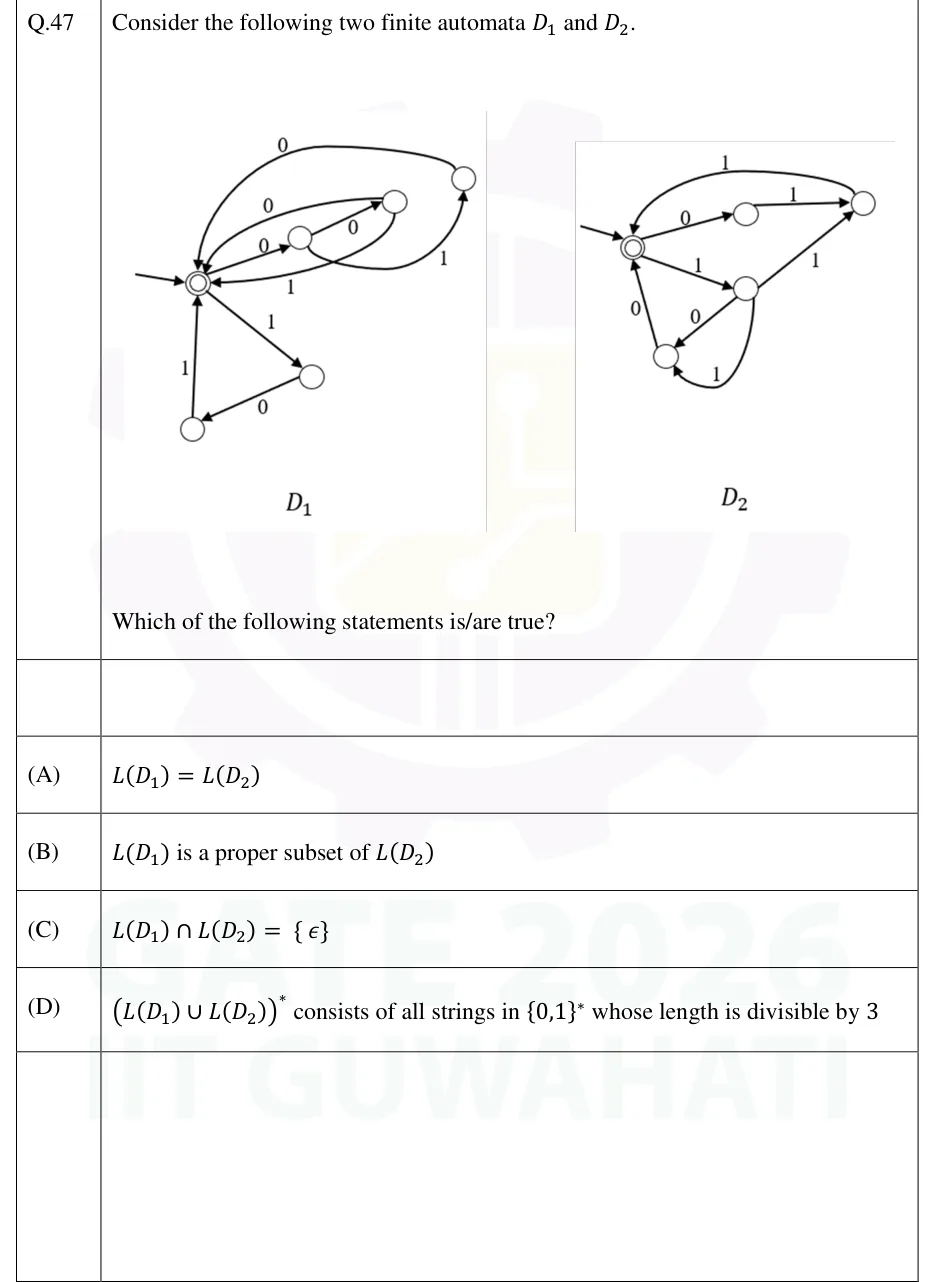
Consider the following two finite automata and .
Which of the following statements is/are true?
 Tap to open full size
Figure description
Two state diagrams over 0,1. D1: five states. The start state q0 is also the only accepting state (double circle). Other states: a, b (both upper right, nearly collinear with q0), c (far upper right), d (lower right) and e (lower left, below q0). Transitions: q0 -0-> b; b -0-> a; a -0-> q0 (upper arc); a -1-> q0 (lower curve); b -1-> c; c -0-> q0 (large outer arc); q0 -1-> d; d -0-> e; e -1-> q0. D2: five states. The start state p0 is also the only accepting state. Other states: f (upper middle), g (upper right), h (middle right) and i (bottom). Transitions: p0 -0-> f; f -1-> g; g -1-> p0 (upper arc); p0 -1-> h; h -1-> g; h -0-> i; h -1-> i (curve); i -0-> p0. Every path from the start state back to it has length exactly 3.
- (A)
- (B)
is a proper subset of
- (C)
- (D)
consists of all strings in whose length is divisible by 3