IAE Academy

GATE 2026 CS1 Q.26: solution and answer

GATE 2026 · CS1Q.26 · 1 mark · MSQ

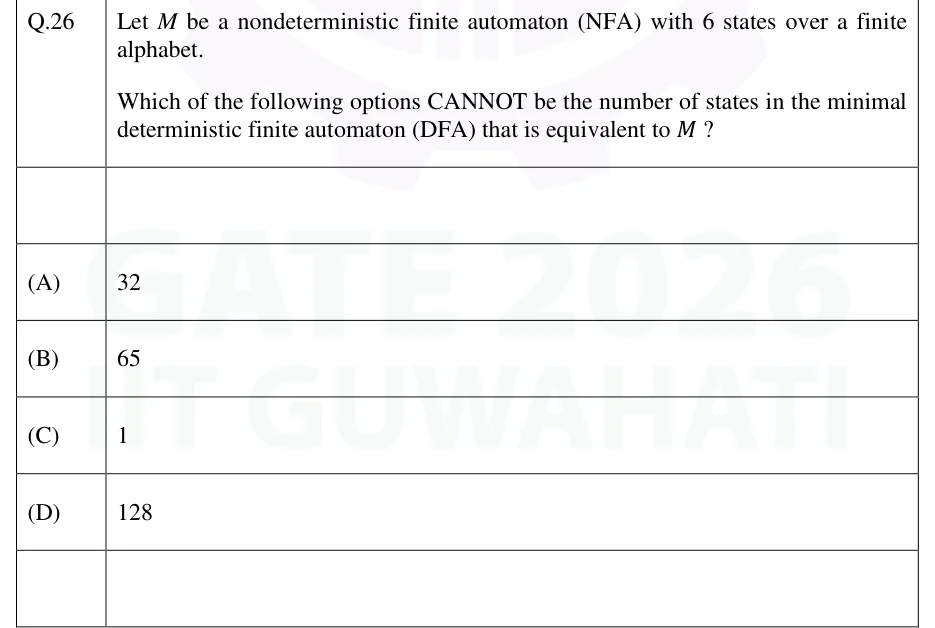
Let be a nondeterministic finite automaton (NFA) with 6 states over a finite alphabet.

Which of the following options CANNOT be the number of states in the minimal deterministic finite automaton (DFA) that is equivalent to ?

  1. (A)

    32

  2. (B)

    65

  3. (C)

    1

  4. (D)

    128

See the question in the paper

Answer and solution

ANSWER

The numbers that cannot occur are 65 and 128, so the answer is B and D.

Official answer: B, DSource: Official answer key, GATE 2026 CS1 (IIT Guwahati)

  1. Subset construction turns an NFA with states into a DFA whose states are subsets of the NFA's states, so there are at most of them.

  2. For this gives at most states. The empty subset (the dead state) is already counted in the 64.

  3. The minimal DFA is never larger than the DFA from the subset construction, so it has at most states. Hence (option B) and (option D) are impossible.

  4. Option C is possible. Take a 6-state NFA for : its start state is accepting and loops on every symbol, and the other five states are unreachable. The minimal DFA for has one state.

  5. Option A is possible. Let be the set of strings over whose 5th symbol from the end is . A 6-state NFA accepts . State loops on and and moves to on . States each move to the next state on both and . State is accepting. The minimal DFA for must remember the last 5 symbols, so it has exactly states.

  6. So 32 and 1 can occur, and 65 and 128 cannot. The options that CANNOT be the size of the minimal DFA are B and D.

KEY IDEA

An NFA with states gives a DFA with at most states. The minimal DFA can be anywhere from 1 up to states, so is the upper limit.

WATCH OUT FOR

Forgetting that the bound is and not (the dead state is the empty subset, already counted), or assuming the minimal DFA must be at least as large as the NFA.

From the GATE 2026 CS1 paper. Every question of this paper · Download the full paper · All 18 Finite automata questions, with notes

More Finite automata questions