
IAE Academy

GATE 2025 CS1 Q.28: solution and answer

GATE 2025 · CS1Q.28 · 1 mark · MSQ

A regular language is accepted by a non-deterministic finite automaton (NFA) with states. Which of the following statement(s) is/are FALSE?

  1. (A)

    may have an accepting NFA with states.

  2. (B)

    may have an accepting DFA with states.

  3. (C)

    There exists a DFA with states that accepts .

  4. (D)

    Every DFA that accepts has states.
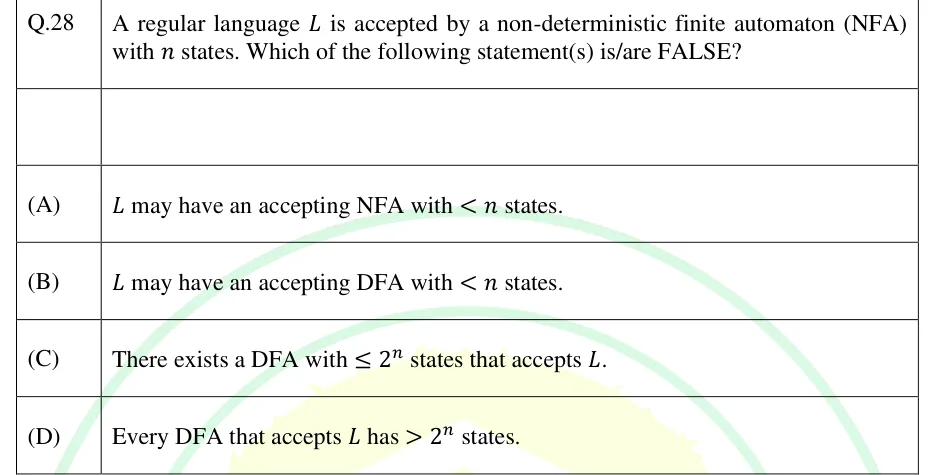
See the question in the paper

Answer and solution

ANSWER

Only statement (D) is false, so the answer is D.

Official answer: DSource: Official answer key, GATE 2025 CS1 (IIT Roorkee)

  1. The question asks which statements are FALSE. The NFA has states, but nothing says is the smallest number of states any NFA for needs.

  2. (A) Take . It is accepted by an -state NFA for any (add extra states that do not change the language). A 1-state NFA also accepts it, and . So may have an NFA with fewer than states, and (A) is TRUE.

  3. (B) In the same example, a 1-state DFA with a single accepting state looping on every symbol accepts , and . So may have a DFA with fewer than states, and (B) is TRUE.

  4. (C) The subset construction turns an -state NFA into a DFA whose states are subsets of the NFA's states. There are at most subsets, so a DFA with states accepting exists. (C) is TRUE.

  5. (D) The claim is that every DFA for has more than states. By (C), some DFA for has at most states, so the claim fails. (D) is FALSE.

  6. Only (D) is a false statement, so the answer is (D).

KEY IDEA

The subset construction gives a DFA with at most states for any -state NFA, so no statement can say every DFA needs more than states. "May have" statements only need one example, such as .

WATCH OUT FOR

Assuming the given NFA is minimal, which makes (A) and (B) look false. Another slip is reading as a lower bound on DFA size, when it is only an upper bound that some languages reach.

From the GATE 2025 CS1 paper. Every question of this paper · Download the full paper · All 18 Finite automata questions, with notes

More Finite automata questions