
IAE Academy

GATE 2024 EC Q.24: solution and answer

GATE 2024 · ECQ.24 · 1 mark · MSQ

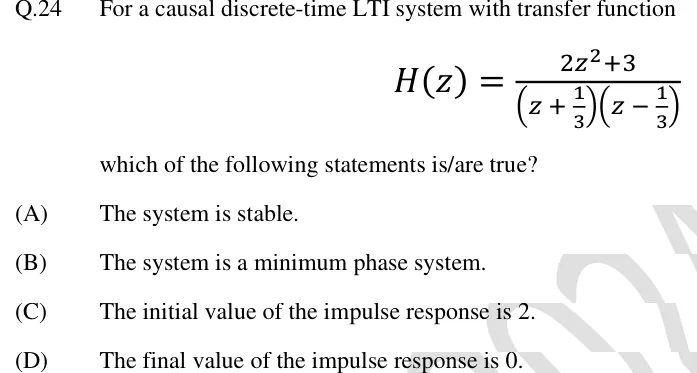
For a causal discrete-time LTI system with transfer function

which of the following statements is/are true?

  1. (A)

    The system is stable.

  2. (B)

    The system is a minimum phase system.

  3. (C)

    The initial value of the impulse response is 2.

  4. (D)

    The final value of the impulse response is 0.
See the question in the paper

Answer and solution

ANSWER

(A), (C) and (D) are true. The poles at lie inside the unit circle, so the causal system is stable. and . The system is not minimum phase because its zeros at lie outside the unit circle.

Official answer: A, C, DSource: Official answer key, GATE 2024 EC (IISc Bengaluru)

  1. Poles: and . The system is causal, so the ROC is the exterior of the outermost pole, , and it contains the unit circle.

  2. Stability (causal system: every pole inside ): , so the system is BIBO stable. (A) is true.

  3. Zeros: , so .

  4. Minimum phase (discrete time): a causal system is minimum phase when every pole and every zero lies inside the unit circle, so that its inverse is also causal and stable. Both zeros lie outside the unit circle, so the inverse system would have poles at and could not be both causal and stable. The system is not minimum phase. (B) is false.

  5. Initial value theorem (causal ): (C) is true.

  6. Final value theorem: it applies here because every pole of , namely , lies inside the unit circle. This agrees with stability, since the impulse response of a stable system decays to zero. (D) is true.

  7. Cross-check by division: With this gives for even , and for odd . So and , which confirms (C) and (D).

  8. Answer: (A), (C), (D).

KEY IDEA

For a causal discrete-time system, poles decide stability (all inside ). Zeros matter too for minimum phase: poles and zeros must all be inside the unit circle. The initial value is . The final value is , and that formula is valid only when has no pole on or outside the unit circle.

WATCH OUT FOR

The common slip is to mark (B) true because both poles are well inside the unit circle, forgetting that minimum phase also requires the zeros inside. Here for both zeros. A second slip is to apply the continuous-time rule (zeros in the left half-plane): these zeros sit on the imaginary axis of the z-plane, but what counts is their magnitude. A third is to take the initial value as or instead of .

From the GATE 2024 EC paper. Every question of this paper · Download the full paper · All 12 z-transform questions, with notes

More z-transform questions