
IAE Academy

GATE 2026 EC Q.15: solution and answer

GATE 2026 · ECQ.15 · 1 mark · MCQ

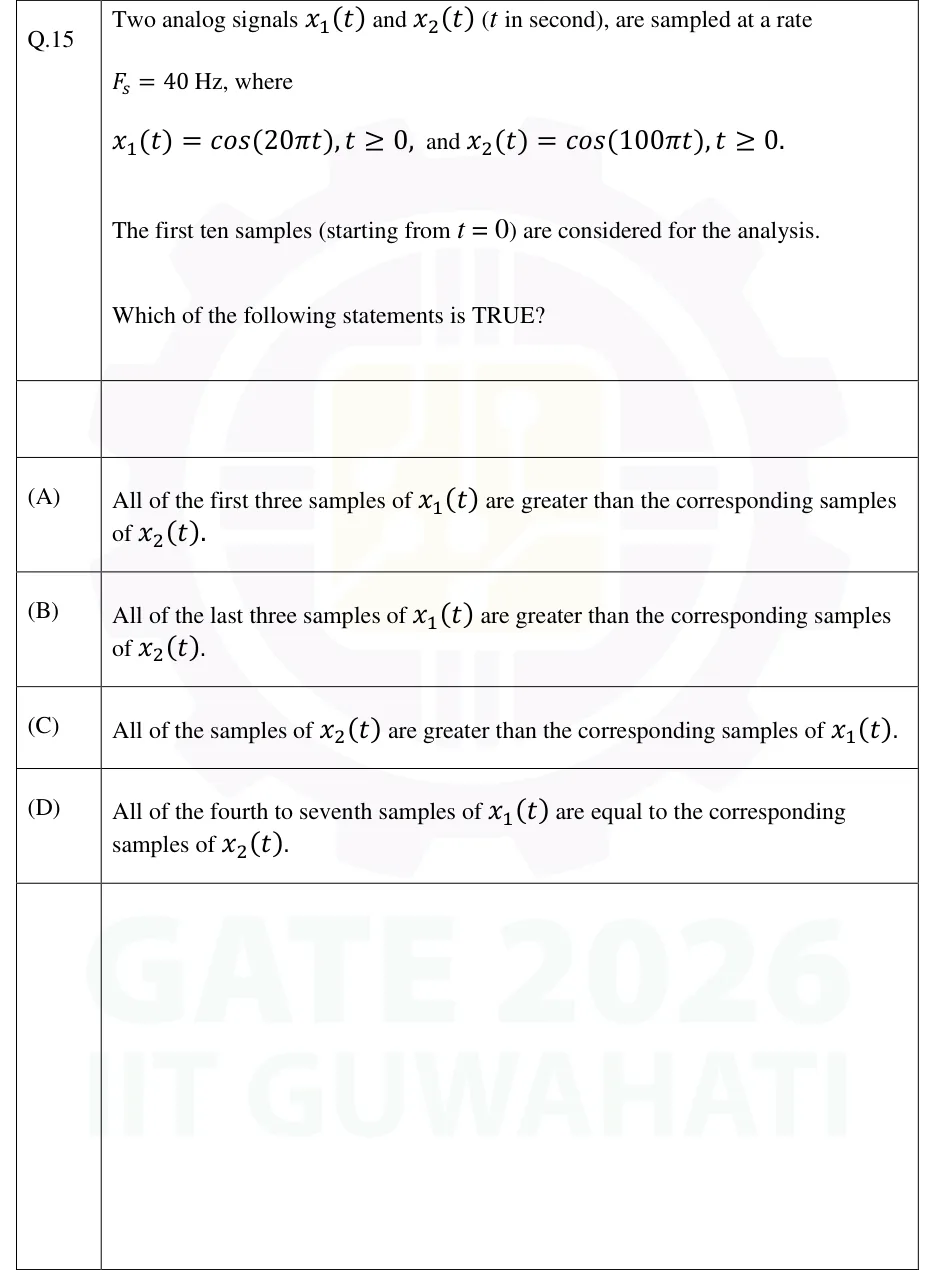
Two analog signals and ( in second), are sampled at a rate , where

, and .

The first ten samples (starting from ) are considered for the analysis.

Which of the following statements is TRUE?

  1. (A)

    All of the first three samples of are greater than the corresponding samples of .

  2. (B)

    All of the last three samples of are greater than the corresponding samples of .

  3. (C)

    All of the samples of are greater than the corresponding samples of .

  4. (D)

    All of the fourth to seventh samples of are equal to the corresponding samples of .
See the question in the paper

Answer and solution

ANSWER

(D) All of the fourth to seventh samples of are equal to the corresponding samples of . In fact, all ten samples are equal, because the signal aliases to at .

Official answer: DSource: Official answer key, GATE 2026 EC (IIT Guwahati)

  1. Sampling at gives sampling instants . The first ten samples, starting from , are .

  2. Samples of : .

  3. Samples of : .

  4. Because is an integer, is a whole number of cycles, and cosine has period : So for every .

  5. Aliasing view of the same fact: is a tone, above , so after sampling it appears at , which is exactly the frequency of . The two sampled sequences cannot be told apart.

  6. Both sequences, for , are .

  7. Every pair of corresponding samples is equal, so no sample of one signal is greater than the other: (A), (B) and (C) are all false. The fourth to seventh samples ( to ) are for both signals, so they are equal and (D) is TRUE.

KEY IDEA

A sinusoid at sampled at gives the same samples as one at for any integer , because the discrete-time frequency is only defined modulo . Here , so aliases exactly onto and every sample matches.

WATCH OUT FOR

Comparing the continuous-time waveforms instead of the samples. oscillates five times faster than , so at most instants the two signals differ, and that tempts students towards (A), (B) or (C). At the sampling instants , though, the extra ( in phase) adds a whole number of cycles, and the samples are identical. A second slip is counting the fourth sample as ; since sampling starts at , the fourth to seventh samples are to . Here that makes no difference because every sample is equal.

From the GATE 2026 EC paper. Every question of this paper · Download the full paper · All 8 Sampling questions, with notes

More Sampling questions