IAE Academy

GATE 2025 EC Q.38: solution and answer

GATE 2025 · ECQ.38 · 2 marks · MCQ

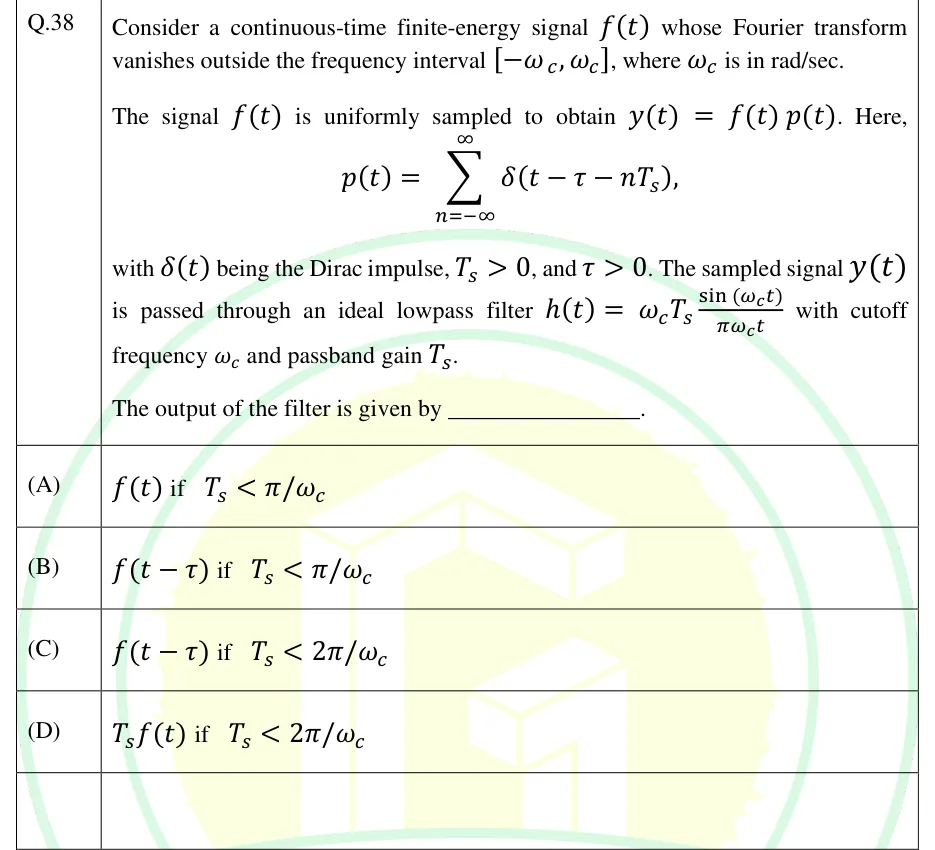
Consider a continuous-time finite-energy signal whose Fourier transform vanishes outside the frequency interval , where is in rad/sec.

The signal is uniformly sampled to obtain . Here,

with being the Dirac impulse, , and . The sampled signal is passed through an ideal lowpass filter with cutoff frequency and passband gain .

The output of the filter is given by ________.

  1. (A)

    if

  2. (B)

    if

  3. (C)

    if

  4. (D)

    if

See the question in the paper

Answer and solution

ANSWER

The filter output is provided . This is option (A).

Official answer: ASource: Official answer key, GATE 2025 EC (IIT Roorkee)

  1. What the sampler produces. By the sifting property, . Each impulse carries the true value of at the instant where it sits, so the offset only moves the sampling grid. It does not delay the signal.

  2. Spectrum of the shifted impulse train. Let . The unshifted train has transform . A shift by multiplies this by , and at each impulse , so

  3. Multiplication theorem (): The copy is and has no phase factor, because . The offset only rotates the phase of the shifted copies ().

  4. The filter. . Since transforms to for and elsewhere, for and elsewhere. This is an ideal LPF with gain .

  5. No-aliasing condition (Nyquist). The copies occupy and its mirror image. The copies with sit even farther out. For every shifted copy to stay clear of the passband we need , which gives

  6. Output. Under that condition only the term passes: The gain cancels the , and there is no delay.

  7. Answer. The output is if , which is option (A). (B) wrongly adds a delay . (C) and (D) use , which only gives and lets the copies alias into the passband. (D) also keeps a stray gain .

KEY IDEA

Shifting the sampling grid by multiplies the -th spectral copy by . The baseband copy () gets , so the offset has no effect on what the lowpass filter recovers. The sampled spectrum carries a factor , which the passband gain cancels. Nyquist () gives .

WATCH OUT FOR

Picking (B) on the belief that the offset delays the output. Here is multiplied by the shifted train, so each impulse carries 's true value at its own instant, and the only -dependent phase lands on the copies, which the filter removes. Other traps: writing the Nyquist condition as , which gives as in (C) and (D), and forgetting that the gain cancels the from sampling, as in (D).

From the GATE 2025 EC paper. Every question of this paper · Download the full paper · All 8 Sampling questions, with notes

More Sampling questions