
IAE Academy

GATE 2022 BT Q.26: solution and answer

GATE 2022 · BTQ.26 · 1 mark · MCQ

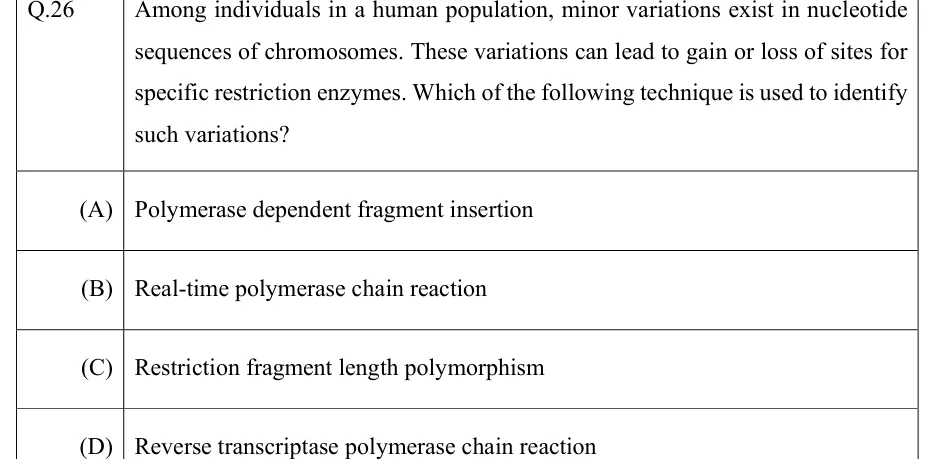
Among individuals in a human population, minor variations exist in nucleotide sequences of chromosomes. These variations can lead to gain or loss of sites for specific restriction enzymes. Which of the following technique is used to identify such variations?

  1. (A)

    Polymerase dependent fragment insertion

  2. (B)

    Real-time polymerase chain reaction

  3. (C)

    Restriction fragment length polymorphism

  4. (D)

    Reverse transcriptase polymerase chain reaction
See the question in the paper

Answer and solution

ANSWER

The technique used to identify such restriction-site variations is (C) Restriction Fragment Length Polymorphism (RFLP).

Official answer: CSource: Official answer key, GATE 2022 BT (IIT Kharagpur)

  1. The stem describes minor inter-individual nucleotide sequence variations that cause gain or loss of specific restriction enzyme recognition sites — this is the defining phenomenon detected by Restriction Fragment Length Polymorphism (RFLP) analysis.

  2. Option (A) 'Polymerase dependent fragment insertion' is not an established molecular biology technique, so it is eliminated.

  3. Option (B) Real-time PCR measures amplicon accumulation via fluorescence to quantify template abundance during amplification cycles; it does not detect the presence or absence of a restriction site, so it is eliminated.

  4. Option (C) RFLP: genomic DNA is digested with a specific restriction enzyme; if a sequence variant creates or abolishes a cut site at that locus, the number and sizes of the resulting fragments differ between individuals. This fragment-size difference, revealed by gel electrophoresis (with or without Southern blotting/probing), is exactly the variation described in the stem — this matches.

  5. Option (D) RT-PCR uses reverse transcriptase to convert RNA to cDNA before amplification, and is used to study transcripts/gene expression; it has no role in detecting genomic restriction-site variation, so it is eliminated.

  6. Therefore, the technique used to identify gain/loss of restriction sites due to sequence variation is RFLP, option (C).

KEY IDEA

A DNA sequence variant (SNP or other minor change) at a restriction enzyme recognition sequence creates or destroys that cut site; digesting genomic DNA with the enzyme and comparing the resulting fragment sizes (by Southern blot or electrophoresis) between individuals reveals the variation — this is RFLP analysis.

WATCH OUT FOR

Confusing RFLP (which detects DNA sequence variation via changes in restriction-digest fragment sizes) with PCR-based quantification or amplification methods (real-time PCR, RT-PCR), which detect gene expression/RNA levels or amplify DNA but do not by themselves reveal restriction-site polymorphisms.

From the GATE 2022 BT paper. Every question of this paper · Download the full paper · All 8 PCR & sequencing questions, with notes

More PCR & sequencing questions