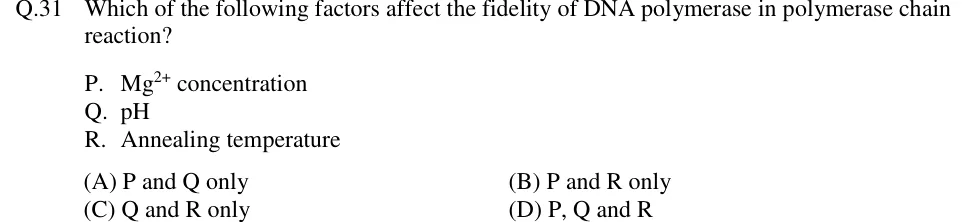
Which of the following factors affect the fidelity of DNA polymerase in polymerase chain reaction?
P. Mg2+ concentration
Q. pH
R. Annealing temperature
- (A)
P and Q only
- (B)
P and R only
- (C)
Q and R only
- (D)
P, Q and R

Which of the following factors affect the fidelity of DNA polymerase in polymerase chain reaction?
P. Mg2+ concentration
Q. pH
R. Annealing temperature
P and Q only
P and R only
Q and R only
P, Q and R
ANSWER
(A) P and Q only. concentration and pH change the polymerase's misincorporation rate. Annealing temperature changes priming specificity, not fidelity.
Official answer: ASource: Official answer key, GATE 2019 BT (IIT Madras)
Define the term first. The fidelity of a DNA polymerase is how accurately it copies the template: how often it inserts the correct complementary dNTP opposite each template base. It is measured as an error rate, for example misincorporations per base per duplication. Specificity is a different property of a PCR. It describes whether the primers anneal only at the intended target sites, so that only the intended product is amplified. The question asks about fidelity only.
P. concentration affects fidelity. is the catalytic cofactor in the polymerase active site, and it also forms the –dNTP complex that the enzyme actually uses as its substrate. Free in excess of the total dNTP concentration stabilises mispaired primer termini and lets the enzyme extend mismatches more easily, so the error rate rises. When is kept close to the total dNTP concentration, fidelity is higher. P is correct.
Q. pH affects fidelity. pH sets the ionisation state of the catalytic and base-selecting residues in the active site, and it also changes how readily the enzyme extends a mismatched terminus. The measured error rate of Taq polymerase changes with the pH of the reaction buffer; it is lower at mildly acidic pH (around 5–6) than at the usual pH of about 8–9. Q is correct.
R. Annealing temperature does not affect fidelity. Annealing temperature controls how stringently the primers hybridise to the template. If it is too low, primers bind at partially matched, off-target sites, which gives non-specific bands and primer-dimers. If it is too high, the primers bind poorly and the yield falls. These are problems of specificity and yield. Annealing temperature does not change how accurately the polymerase chooses each nucleotide during extension. Even a mis-primed product is copied at the enzyme's normal per-base error rate, because the polymerase still reads the template base by base. R is therefore not a fidelity factor.
Eliminate the options. (B), (C) and (D) all include R, so each of them is wrong. Only (A) contains both fidelity factors, P and Q, and excludes R.
Answer: (A) P and Q only.
KEY IDEA
Fidelity is the polymerase's per-base copying accuracy, and specificity is where the primers bind. Reaction chemistry at the active site changes fidelity: free in excess of dNTPs, pH, and an unbalanced dNTP pool. Annealing temperature changes primer–template stringency, which affects specificity and yield, not fidelity.
WATCH OUT FOR
Treating 'fidelity' as meaning 'anything that gives a wrong PCR product', and so choosing (D). A low annealing temperature causes mispriming and non-specific bands. That is a failure of specificity, not a change in how accurately the polymerase inserts nucleotides.
From the GATE 2019 BT paper. Every question of this paper · Download the full paper · All 8 PCR & sequencing questions, with notes