
IAE Academy

GATE 2020 BT Q.27: solution and answer

GATE 2020 · BTQ.27 · 2 marks · MCQ

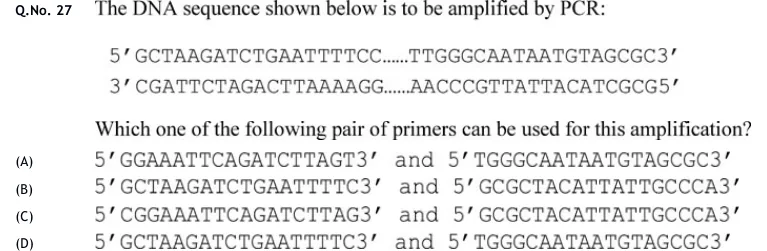
The DNA sequence shown below is to be amplified by PCR:
5'GCTAAGATCTGAATTTTCC......TTGGGCAATAATGTAGCGC3'
3'CGATTCTAGACTTAAAAGG......AACCCGTTATTACATCGCG5'
Which one of the following pair of primers can be used for this amplification?

  1. (A)

    5'GGAAATTCAGATCTTAGT3' and 5'TGGGCAATAATGTAGCGC3'

  2. (B)

    5'GCTAAGATCTGAATTTTC3' and 5'GCGCTACATTATTGCCCA3'

  3. (C)

    5'CGGAAATTCAGATCTTAG3' and 5'GCGCTACATTATTGCCCA3'

  4. (D)

    5'GCTAAGATCTGAATTTTC3' and 5'TGGGCAATAATGTAGCGC3'
See the question in the paper

Answer and solution

ANSWER

The correct answer is (B): 5'GCTAAGATCTGAATTTTC3' and 5'GCGCTACATTATTGCCCA3'.

Official answer: BSource: Official answer key, GATE 2020 BT (IIT Delhi)

  1. The forward primer must have the identical sequence (5'->3') to the top (sense) strand at the left end of the target, because it anneals to the bottom strand and is extended rightward using the bottom strand as template.

  2. Top strand's printed 5' end is 5'GCTAAGATCTGAATTTTCC3'. Only options B and D offer this exact sequence (as the 18-nt truncation GCTAAGATCTGAATTTTC), which rules out A and C — their first primers are reverse-complement-style sequences, not direct copies, and so cannot serve as the forward primer.

  3. The reverse primer must anneal to the top strand at the right end of the target, so it must be the reverse complement of the top strand's 3' segment, not a direct copy of it.

  4. Top strand's 3' end is 5'...TTGGGCAATAATGTAGCGC3'. Complementing each base (without reversing order) gives AACCCGTTATTACATCGCG — this matches the bottom strand's printed 3' segment in the figure, confirming the complement is correct. Reversing this string to express it in standard 5'->3' orientation gives GCGCTACATTATTGCCCAA.

  5. Option D's second primer, TGGGCAATAATGTAGCGC, is simply a direct (truncated) copy of the top strand's own 3' end — the same polarity as the top strand itself — so it cannot function as a valid reverse primer.

  6. Option B's second primer, GCGCTACATTATTGCCCA, matches the correctly computed reverse-complement primer GCGCTACATTATTGCCCAA (truncated by one base at the 3' end) — this is the valid reverse primer.

  7. With a correctly matching forward primer (shared by B and D) and only B carrying a correctly oriented reverse primer, the two primers in option B point toward each other and flank the target region, enabling amplification.

  8. Therefore option (B) is the only pair of primers that can correctly amplify the shown DNA sequence by PCR.

KEY IDEA

In PCR, the forward primer has the same sequence (5'->3') as the top/sense strand at the left end of the target region (it primes synthesis off the bottom strand template), while the reverse primer has the same sequence as the bottom strand's 5' end — i.e., it is the reverse complement of the top strand's 3' end (it primes synthesis off the top strand template). A primer that merely copies the printed top-strand sequence at the right end, without reverse-complementing it, cannot function as a reverse primer.

WATCH OUT FOR

Picking a "primer" that is simply the top strand's own 3' end sequence copied as printed (option D's second primer, TGGGCAATAATGTAGCGC) instead of its reverse complement — this sequence is identical in polarity to the template strand it needs to hybridize to and therefore cannot anneal and prime synthesis in the required direction.

From the GATE 2020 BT paper. Every question of this paper · Download the full paper · All 8 PCR & sequencing questions, with notes

More PCR & sequencing questions