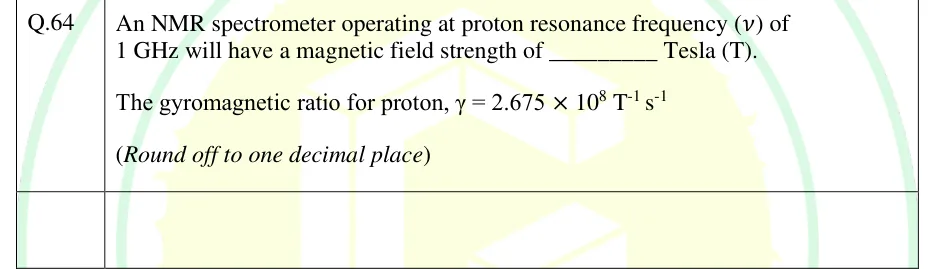
An NMR spectrometer operating at proton resonance frequency (ν) of 1 GHz will have a magnetic field strength of __________ Tesla (T).
The gyromagnetic ratio for proton, γ = 2.675 × 10^8 T^-1 s^-1
(Round off to one decimal place)

An NMR spectrometer operating at proton resonance frequency (ν) of 1 GHz will have a magnetic field strength of __________ Tesla (T).
The gyromagnetic ratio for proton, γ = 2.675 × 10^8 T^-1 s^-1
(Round off to one decimal place)
ANSWER
B0 ≈ 23.5 T
Official answer: 23.2 to 23.8Source: Official answer key, GATE 2025 BT (IIT Roorkee)
Recognize the governing relation: the NMR resonance (Larmor) condition is ω = γB₀, where ω is the angular precession frequency of the proton in the magnetic field B₀ and γ is the proton's gyromagnetic ratio.
Relate angular frequency to the given resonance frequency ν: ω = 2πν, so ν = γB₀/(2π).
Solve for the field strength: B₀ = 2πν/γ.
Convert the given frequency to SI units: ν = 1 GHz = 1×10^9 Hz.
Substitute the given values: γ = 2.675×10^8 T^-1 s^-1, so B₀ = 2π(1×10^9)/(2.675×10^8).
Compute: 2π×10^9 = 6.283185307×10^9, and 6.283185307×10^9 / 2.675×10^8 ≈ 23.4885 T.
Round to one decimal place as instructed: B₀ ≈ 23.5 T.
KEY IDEA
The NMR resonance condition (Larmor equation) relates the applied magnetic field to the resonance (Larmor) frequency through the gyromagnetic ratio of the nucleus: the angular frequency ω = γB₀, and ω = 2πν, so ν = γB₀/(2π), giving B₀ = 2πν/γ.
WATCH OUT FOR
Using ν directly in the Larmor equation ω = γB0 without converting ν to angular frequency (forgetting the factor of 2π), which gives a wrong field strength off by a factor of ~6.28.
From the GATE 2025 BT paper. Every question of this paper · Download the full paper · All 8 Microscopy & spectroscopy questions, with notes