IAE Academy

GATE 2022 BT Q.45: solution and answer

GATE 2022 · BTQ.45 · 2 marks · MCQ

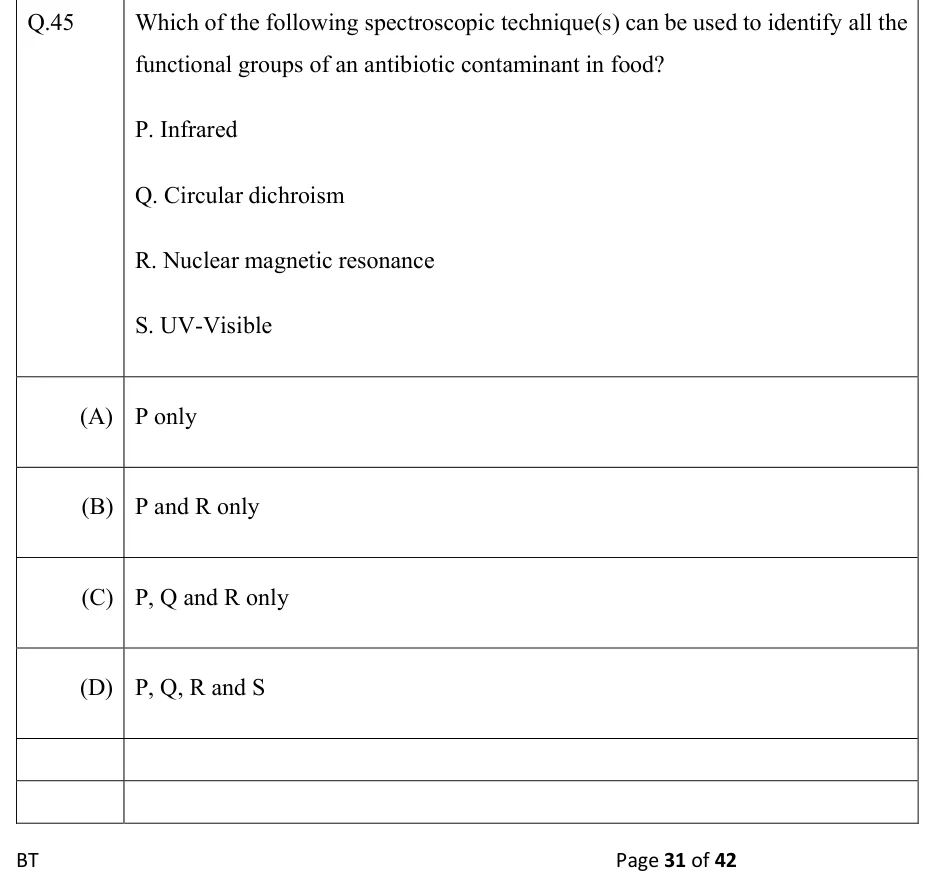
Which of the following spectroscopic technique(s) can be used to identify all the functional groups of an antibiotic contaminant in food?

P. Infrared

Q. Circular dichroism

R. Nuclear magnetic resonance

S. UV-Visible

  1. (A)

    P only

  2. (B)

    P and R only

  3. (C)

    P, Q and R only

  4. (D)

    P, Q, R and S

See the question in the paper

Answer and solution

ANSWER

(B) P and R only: infrared and NMR spectroscopy can identify all the functional groups. Circular dichroism reports only chirality and conformation, and UV-Visible sees only chromophores.

Official answer: BSource: Official answer key, GATE 2022 BT (IIT Kharagpur)

  1. Work out what each technique measures. To find every functional group in an unknown small molecule such as an antibiotic residue, the technique must give a signal for each group, whether or not that group absorbs light or makes the molecule chiral.

  2. P. Infrared: yes. IR absorption comes from bond vibrations (stretching and bending). Every common functional group has its own absorption band: C=O near – (amide, ester, ketone, and a strained -lactam carbonyl at the high end), O–H and N–H stretches near –, C≡N near , and aromatic C=C near –. That makes IR the standard technique for identifying functional groups.

  3. R. Nuclear magnetic resonance: yes. In and NMR, the chemical shift of a nucleus depends on its electronic environment, so each functional group gives characteristic signals. Examples: aldehyde H near –, carboxylic-acid H near –, aromatic H near –, and carbonyl carbons near – in NMR. NMR also detects carbons that carry no hydrogen, including quaternary and carbonyl carbons. Coupling patterns and 2D experiments then show how the groups are connected. So NMR identifies functional groups and also places them in the molecule. Together, IR and NMR are the standard pair for identifying the structure of an organic contaminant.

  4. Q. Circular dichroism: no. CD measures the difference in absorption of left- and right-circularly polarised light (). It gives a signal only for chiral chromophores and is used to study chirality and the secondary structure of proteins and nucleic acids. It does not report which functional groups are present, and a group with no chiral chromophore nearby gives no CD signal.

  5. S. UV-Visible: no. UV-Vis measures electronic transitions, so it responds only to chromophores (conjugated systems, aromatic rings, some carbonyls). Many functional groups, such as isolated alcohols, ethers, amines and alkyl halides, absorb little or nothing in the usable range. The spectrum is also a few broad bands, which cannot resolve a molecule's groups one by one.

  6. The techniques that can identify all the functional groups are therefore P (IR) and R (NMR). The answer is (B) P and R only.

KEY IDEA

A technique can identify every functional group only if every group gives it a signal. IR does this through bond vibrations, and NMR does it through the chemical shifts of and nuclei. CD needs a chiral chromophore and UV-Vis needs a chromophore, so both miss most groups.

WATCH OUT FOR

Choosing (A) because IR is thought of as the only functional-group technique. NMR chemical shifts are just as diagnostic of functional groups ( NMR detects even carbonyl and quaternary carbons), and IR with NMR is the standard pair for structure elucidation. Choosing (D) is the opposite mistake: CD and UV-Vis give signals only from chiral chromophores and chromophores respectively.

From the GATE 2022 BT paper. Every question of this paper · Download the full paper · All 8 Microscopy & spectroscopy questions, with notes

More Microscopy & spectroscopy questions