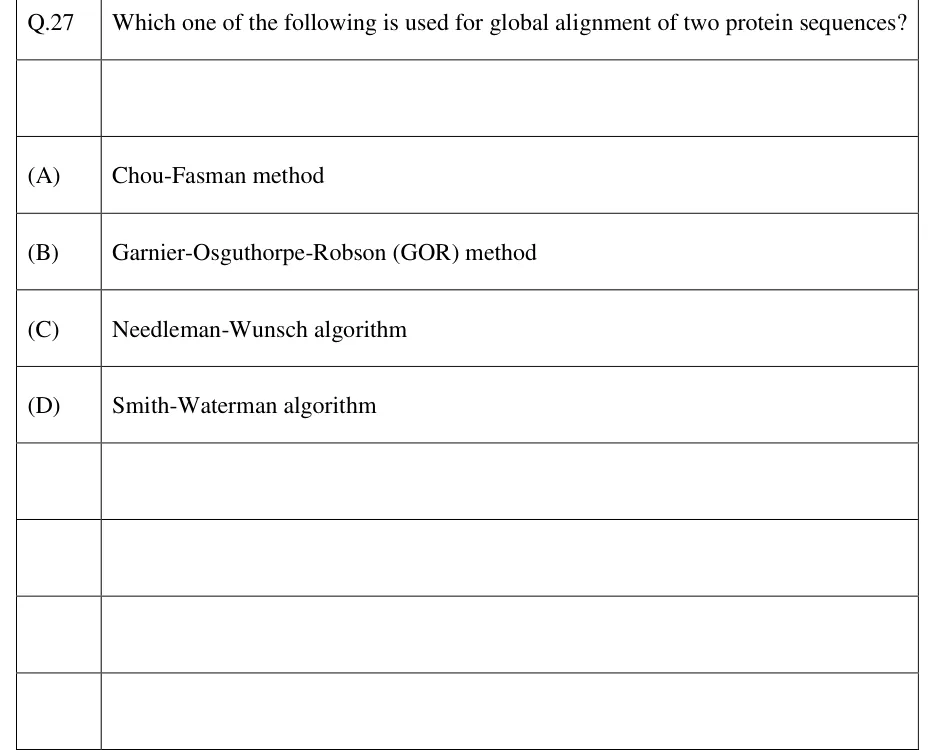
Which one of the following is used for global alignment of two protein sequences?
- (A)
Chou-Fasman method
- (B)
Garnier-Osguthorpe-Robson (GOR) method
- (C)
Needleman-Wunsch algorithm
- (D)
Smith-Waterman algorithm

Which one of the following is used for global alignment of two protein sequences?
Chou-Fasman method
Garnier-Osguthorpe-Robson (GOR) method
Needleman-Wunsch algorithm
Smith-Waterman algorithm
ANSWER
The correct answer is (C) Needleman-Wunsch algorithm.
Official answer: CSource: Official answer key, GATE 2023 BT (IIT Kanpur)
Chou-Fasman method (A): an empirical statistical method that predicts protein secondary structure (helix/sheet/turn propensities) from the amino acid sequence. It is a structure-prediction tool, not a sequence alignment method. Eliminated.
Garnier-Osguthorpe-Robson (GOR) method (B): another secondary-structure prediction method, based on information theory applied to sequence windows. Also not an alignment algorithm. Eliminated.
Needleman-Wunsch algorithm (C): a dynamic-programming algorithm that aligns the entire length of both input sequences end-to-end, inserting gaps as needed to maximize the overall alignment score. This is precisely the definition of global alignment.
Smith-Waterman algorithm (D): a dynamic-programming algorithm that finds the highest-scoring local region of similarity between two sequences; the alignment can start and end anywhere and excludes poorly matching regions. This is local alignment, not global. Eliminated despite also being a well-known alignment tool.
Since the question asks specifically for the algorithm used for global alignment of two protein sequences, and Needleman-Wunsch is the standard global-alignment algorithm (paired conceptually with Smith-Waterman for local alignment), option (C) is correct.
KEY IDEA
Needleman-Wunsch is the classic dynamic-programming algorithm for global sequence alignment (aligns full length, end to end); Smith-Waterman is its local-alignment counterpart (best-scoring subregion only). Chou-Fasman and GOR are unrelated secondary-structure prediction methods, not alignment algorithms.
WATCH OUT FOR
Confusing Needleman-Wunsch (global) with Smith-Waterman (local) since both are DP-based pairwise alignment algorithms — remembering "N for 'k(N)ow the whole thing' = global" or simply memorizing the pairing (Needleman-Wunsch = Global, Smith-Waterman = Local) avoids the mix-up. A secondary mistake is confusing alignment algorithms with secondary-structure prediction methods (Chou-Fasman, GOR), which solve a completely different problem.
From the GATE 2023 BT paper. Every question of this paper · Download the full paper · All 11 Bioinformatics questions, with notes