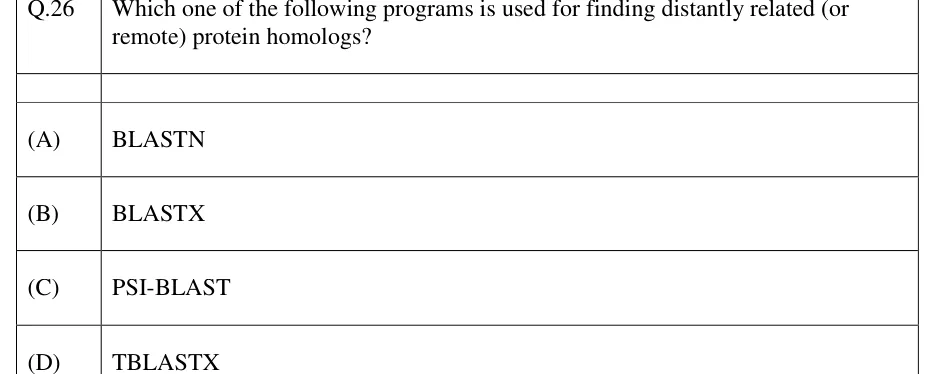
Which one of the following programs is used for finding distantly related (or remote) protein homologs?
- (A)
BLASTN
- (B)
BLASTX
- (C)
PSI-BLAST
- (D)
TBLASTX

RECOMBINANT DNA TECHNOLOGY AND TOOLS · BIOINFORMATICS
Which one of the following programs is used for finding distantly related (or remote) protein homologs?
BLASTN
BLASTX
PSI-BLAST
TBLASTX
ANSWER
The answer is (C) PSI-BLAST.
Official key: C · Official answer key, GATE 2023 BT (IIT Kanpur)
BLASTN aligns a nucleotide query against a nucleotide database; it does not address protein homology at all, so it is not the tool sought here.
BLASTX translates a nucleotide query (all six reading frames) and searches it against a protein database in a single-pass alignment — useful for identifying a likely protein match but not specialized for remote/distant homology detection.
TBLASTX translates both the nucleotide query and a nucleotide database (six frames on each side) and compares the translated sequences — again a single, direct alignment pass; computationally heavy but not iterative, so it offers no special sensitivity boost for remote homologs.
PSI-BLAST (Position-Specific Iterated BLAST) runs an initial BLAST search, then builds a position-specific scoring matrix (profile) from the statistically significant hits, and repeats the profile search over multiple iterations.
This iterative, profile-based refinement is precisely what amplifies weak or distant sequence similarity signals that a single-pass alignment (as in A, B, D) would miss, making PSI-BLAST the standard choice for detecting distantly related (remote) protein homologs.
Therefore option (C) PSI-BLAST is correct; options (A) BLASTN, (B) BLASTX, and (D) TBLASTX are each single-pass tools not designed for remote homology detection.
KEY IDEA
PSI-BLAST (Position-Specific Iterated BLAST) builds and iteratively refines a position-specific scoring matrix (profile) from initial hits, which amplifies weak, distant sequence similarity — making it the standard BLAST variant for detecting remote protein homologs, unlike the single-pass BLASTN/BLASTX/TBLASTX searches.
COMMON MISTAKE
Picking BLASTX or TBLASTX because they sound more "thorough" (translated searches), while missing that PSI-BLAST's iterative profile refinement — not translation of nucleotide frames — is what specifically boosts sensitivity to distant/remote homologs.
From the GATE 2023 BT paper. Every question of this paper · Download the full paper · All 11 Bioinformatics questions, with notes