
IAE Academy

GATE 2022 BT Q.44: solution and answer

GATE 2022 · BTQ.44 · 2 marks · MCQ

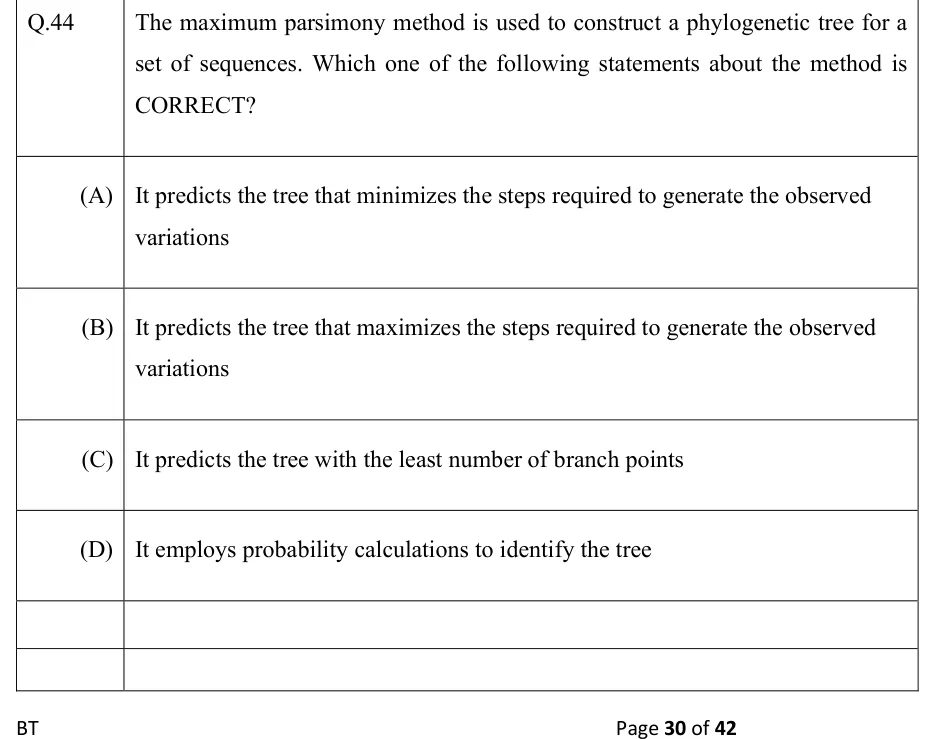
The maximum parsimony method is used to construct a phylogenetic tree for a set of sequences. Which one of the following statements about the method is CORRECT?

  1. (A)

    It predicts the tree that minimizes the steps required to generate the observed variations

  2. (B)

    It predicts the tree that maximizes the steps required to generate the observed variations

  3. (C)

    It predicts the tree with the least number of branch points

  4. (D)

    It employs probability calculations to identify the tree
See the question in the paper

Answer and solution

ANSWER

The correct answer is (A): maximum parsimony predicts the tree that minimizes the number of steps (character-state changes) required to generate the observed sequence variations.

Official answer: ASource: Official answer key, GATE 2022 BT (IIT Kharagpur)

  1. The maximum parsimony method evaluates all candidate tree topologies for a set of aligned sequences and, for each, counts the minimum number of character-state changes (substitutions) needed along its branches to explain the observed sequence variation.

  2. It then selects the tree(s) requiring the smallest total number of such changes — i.e., the tree that minimizes the steps required to generate the observed variations. This is exactly option (A), so (A) is CORRECT.

  3. Option (B) states the opposite (maximizes the steps), which contradicts the parsimony principle of favoring the most economical explanation, so (B) is WRONG.

  4. Option (C) refers to the number of branch points (nodes/topology), not the number of character-state changes; parsimony scores are step counts, not node counts, and a tree with fewer branch points is not what the method selects for, so (C) is WRONG.

  5. Option (D) describes maximum likelihood or Bayesian phylogenetic methods, which use explicit probability/substitution models — maximum parsimony is a discrete, combinatorial counting method with no probability calculation, so (D) is WRONG.

  6. Hence only (A) correctly describes maximum parsimony.

KEY IDEA

Maximum parsimony selects, among all possible tree topologies, the one(s) requiring the fewest total character-state changes (evolutionary steps) to explain the observed sequence data — it minimizes tree length, not node count, and uses no probability model.

WATCH OUT FOR

Confusing the parsimony criterion (minimum number of character-state changes/steps) with the number of branch points or nodes in the tree (option C), or mistaking parsimony for a probability-based method like maximum likelihood (option D).

From the GATE 2022 BT paper. Every question of this paper · Download the full paper · All 11 Bioinformatics questions, with notes

More Bioinformatics questions